A Red Chamber Family Tree Reading Path
Revised · Chapter-limited literary guide
Start with the chapter in front of you. Add a person to your notes only when a relationship or action helps explain that scene. This route shows when to consult a family diagram, when to record a household role, and when to keep reading.
Reading scope: Early relationship examples from chapters 1–4 and 6; reading tasks extend through chapter 10. No later character outcomes.
Start with a reading route, then consult the tree
A family tree answers who is related to whom. A reading route answers what you need to understand now. In Dream of the Red Chamber, those questions diverge: an early chapter may describe a relative who is not present, bring a visitor into a household, or introduce someone through a servant’s report. Trying to memorize every name first makes all three situations look alike.
Use this page alongside your book, not as a replacement for chapters 1–10. Its early examples identify relationships already stated in chapters 1–4 and 6. The later steps are tasks for your own reading; they do not disclose later marriages, deaths or dream fulfilments. If you need the diagram itself, open the family tree limited to chapters 1–5.
Prepare one page of notes with four columns: person, connection, present scene, and source. A source can be “chapter 2, the conversation about the Jia family” rather than a perfect page citation on your first pass. Leave uncertain information blank. An empty field is more useful than a confident relationship copied from a search result that reveals a later development.
Chapter 1: keep the frame separate from the family chart
The novel does not begin with a neat introduction to everyone in the Jia household. The Stone’s account, a dream and Zhen Shiyin’s worldly circumstances precede the main family introductions. Zhen Shiyin and Jia Yucun are different people. Do not place them in one box because both appear in the opening or because the narrative plays with names and truth. [1]
For this stage, record only the roles needed to follow events: Shiyin as host and benefactor, Yucun as the poor scholar he helps, and Shiyin’s daughter as the child whose disappearance changes the household. Write “dream conversation” beside information encountered in the dream. This prevents you from treating an account of an earlier supernatural connection as an ordinary family introduction.
Your checkpoint is a short explanation of the transition from the frame to Shiyin’s losses. You do not need to identify every eventual human counterpart of a supernatural figure. The chapter 1 guide supplies a chronological account if the shifts are confusing. Return to the book once you can distinguish the layers.
Chapter 2: build the first connections from a reported account
Chapter 2 provides a conversation about the Jia family. Treat this as information supplied by a speaker, not as a scene in which every named person enters the room. Record the two household branches and only the connections that explain the next arrival. Jia She and Jia Zheng belong to the Rongguo branch; Jia Lian is Jia She’s son, and Wang Xifeng is Jia Lian’s wife. [2]
This is also the point to note that marriage can connect a person with more than one family. Xifeng’s marriage ties her to the Jia household, while her connection with Lady Wang helps explain references to the Wang family. “Wang” does not make every bearer of that surname interchangeable, and “Jia” alone does not tell you which household or generation is involved.
Keep the word “reported” in the source column for judgments about temperament or competence. A later observed action may support or complicate the report. Separating those entries lets you notice how the novel introduces reputation before it shows conduct. It also gives you something more useful to discuss than a fixed adjective copied onto the tree.
Chapter 3: follow Daiyu’s arrival through people and rooms
Lin Daiyu’s arrival turns a reported family into an encounter. She is the daughter of Jia Min, Grandmother Jia’s daughter. Her connection with this elder explains her reception, but the chapter also shows greeting, seating, service and movement between rooms. Those actions are a second kind of evidence. [2, 3]
Read the arrival once without opening every character page. On the second pass, add a connection only when it helps you understand an exchange. For example, Xifeng is not merely another young woman in the gathering: Grandmother Jia addresses her familiarly, and Lady Wang asks her about practical household matters. A family relationship and a managerial task belong in separate columns.
Watch who speaks about another person, who answers, and who performs a task. Daiyu’s own interpretation of what she sees also matters. A respectful greeting does not establish biological parentage; a person standing to serve is not necessarily less important to the running of the household. The household-rank guide explains these distinctions.
At this checkpoint, aim to explain Daiyu’s connection to the elder, Xifeng’s connection to Jia Lian and Lady Wang, and Baoyu’s place in Jia Zheng’s family. If one remains unclear, check the limited diagram. If they are clear, reading the next scene is a better use of time than expanding the chart with relatives who have not become relevant.
Chapter 4: add the Xue visitors without changing their parentage
The Xue family introduces another set of connections. Xue Baochai is Xue Pan’s sister; their mother, Aunt Xue, is Lady Wang’s sister. Residence in the Jia household does not make Baochai a daughter of Lady Wang or a sister of Baoyu. A useful note keeps “mother” separate from “aunt” and “staying here” separate from “born into this family.” [4]
For a first reading, add three lines: Baochai—Aunt Xue’s daughter; Xue Pan—Baochai’s brother; Aunt Xue—Lady Wang’s sister. Then attach the residence information to the scene rather than drawing a new parent-child line. You can understand a visitor’s access and position without predicting a later relationship.
The chapter contains other material that is not needed for this particular family checkpoint. Do not turn a quick relationship lookup into a search for everyone’s eventual fate. Write a question such as “How does staying here affect the next encounter?” and let the next chapter answer it in order.
Chapters 5–10: extend notes only when the scene asks for them
From chapter 5 onward, keep using the same small record. For a passage presented as a dream, poem or judgment, identify its voice before adding its claims to a person’s biography. You can mark “the passage associates these names” without deciding that it reports an event already completed. The early poetry worksheet provides a separate exercise in speaker and context.
Chapter 6 offers a concrete test of why a family chart alone is insufficient. Liu Laolao’s route to Xifeng involves a claimed connection, intermediaries and access. The Wang connection described in this chapter is an affiliation through a shared surname, not straightforward proof of close blood kinship. Zhou Rui’s wife and Ping’er help make the encounter possible. Record their actions even if they do not belong on your bloodline diagram. [5]
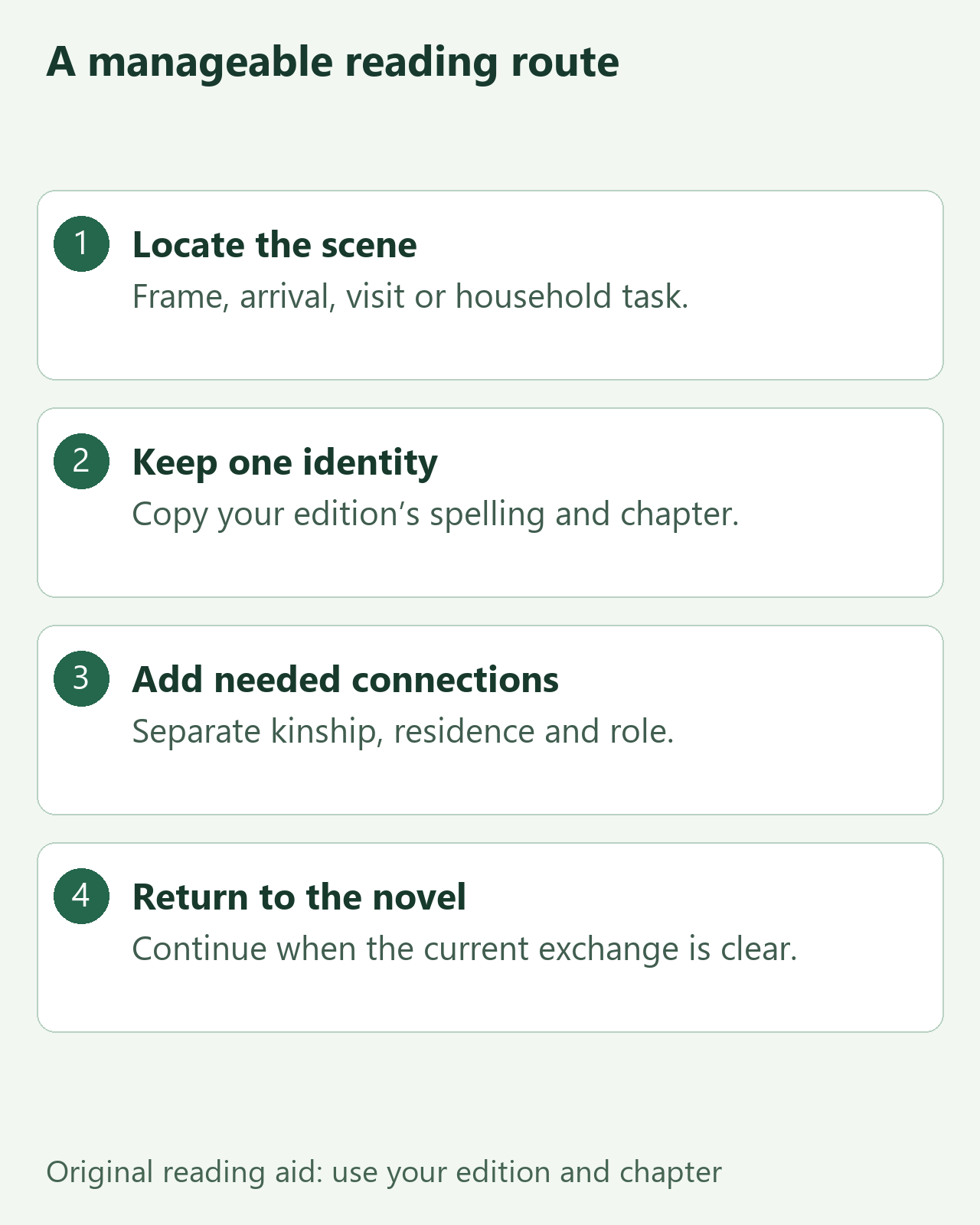
For chapters 7–10, add a person when that person’s action changes an exchange you are following. Put service, school or household business in the scene column rather than inventing a genealogical link. If the chapter introduces an unfamiliar label, copy the spelling your edition uses and leave a question mark until the text supplies a connection.
At the end of chapter 10, choose one encounter and retell who sought what from whom. Use the chapters 1–10 questions for a fuller check, or the chapter 10 guide for that chapter’s particular difficulties. You should now have a working map, not an exhaustive index.
Use a checkpoint before opening another reference
The table below is a route through reading problems. It is not a proposed replacement chapter order. Stay with the novel’s order and use the smallest reference that resolves the current obstacle.
On a narrow screen, scroll the table sideways to read all columns.
| Where you are | What to write | Enough to continue |
|---|---|---|
| Chapter 1 | Frame, dream and worldly scene in separate entries | You can follow Shiyin and Yucun without merging them. |
| Chapter 2 | Branch, parent or spouse, and the speaker reporting it | You can distinguish the two Jia branches and Xifeng’s connections. |
| Chapter 3 | Arrival, greeting, request and response | You can explain Daiyu’s reception and one household task. |
| Chapter 4 | Mother, sibling, aunt and residence separately | Baochai’s stay has not become an invented parent-child relationship. |
| Chapters 5–6 | Voice of a passage; intermediaries in an encounter | A judgment and an access route remain different evidence. |
| Chapters 7–10 | One scene-specific action for each relevant new person | You can retell an exchange without searching for future outcomes. |
When a reference does not solve the obstacle, describe the obstacle more precisely. “Too many names” might mean uncertain spelling, unclear kinship or difficulty locating a room. A name card, tree and household diagram address different problems. Choose among them after naming the question.
Keep one edition as the anchor for your notes
Translations vary in spelling, retained Chinese titles and the amount of explanation placed in notes. Copy the first spelling in your own edition, then add an alternative in brackets only after confirming that the context identifies the same person. Do not replace your notes wholesale with another translation’s labels.
Write the edition or translator at the top of the record. Add page references as you revise a discussion or essay, when exact locations become useful. The linked Chinese chapter texts are working texts with editorial and variant material; they do not establish identical wording in every edition.
After this route, your next useful task is probably a scene comparison: how someone is described in chapter 2 and what that person does in chapter 3 or 6. A small, sourced map supports that comparison. A list of unlocated names does not.
Worked reading examples
Each example shows how to check a reading claim against the stated chapter or passage.
Daiyu appears in a different spelling
Your book prints Tai-yu, while a reference uses Daiyu. You do not start a second character entry. Compare the surrounding introduction: the visitor is Lin’s daughter received by Grandmother Jia. Once the identity is confirmed, retain the spelling from your edition and add the alternative in brackets. The relationship and scene establish the match; resemblance of letters alone would be weaker evidence.
Baochai is staying with the Jia family
A reader draws a line from Lady Wang to Baochai because they are in the same household. Correct the line using chapter 4: Aunt Xue is Baochai’s mother and Lady Wang’s sister. Put the stay in the scene column. This preserves the aunt relationship and allows later encounters to be interpreted without making residence equal parentage.
A service role does not fit the tree
You can identify Xifeng’s husband but cannot explain how Liu Laolao reaches her in chapter 6. Add Zhou Rui’s wife and Ping’er to a separate encounter note: who carries information, who receives the visitor and who grants access. They need not become blood relatives to be important. The encounter note solves an obstacle that a larger genealogy would leave intact.
A name search starts revealing later events
You look up a person from chapter 3 and see a heading about a later outcome. Close that result and return to the chapter-limited diagram. Record only the introduction, connection and current action. If the text has not clarified a label, keep the question open. A temporary uncertainty protects your first reading and can be resolved when the novel supplies the next encounter.
First-ten-chapters reading record
Use this optional text record to keep an edition, passage, observation and interpretation together. Leave unconfirmed information open. Downloading the blank record does not send your completed notes to this site.
Frequently asked questions
Should I memorize the family tree before reading?
No. Start with a few connections required by the current chapter and use a limited diagram when one is unclear. Expand notes through scenes, not a complete list of future characters. This keeps relationships attached to evidence and reduces accidental spoilers.
Does living in Rongguo or Ningguo make someone a blood relative?
No. A household includes visitors, spouses, servants and other connections as well as descendants. Record residence, parentage and role separately. Chapter 4’s Xue residence and chapter 6’s access route are useful early checks.
Is this the complete novel in ten chapters?
No. This is a reading route through the first ten chapters. Its checkpoints do not summarize the entire novel or reveal how later relationships develop. Continue with your chosen edition after using the opening-chapters exercises.
When should I use the names guide instead of the family diagram?
Use the names guide when the obstacle is a spelling, courtesy name, kinship address or title for someone you can otherwise identify. Use the diagram when you need a parent, sibling, spouse or branch connection. For a question about permission or household work, use the rank guide.
Choose the next reading task
Sources and what they support
- Dream of the Red Chamber, chapter 1
Chapter coverage: Stone frame, dream, hospitality, departure, disappearance, fire, song and closing transition. Editorial material is kept distinct from character speech.
- Dream of the Red Chamber, chapter 2
Chapter coverage: the reported family account, branch and relationship information, and stated positions. A speaker’s report remains distinguishable from an observed action.
- Dream of the Red Chamber, chapter 3
Chapter coverage: Daiyu’s arrival, relationships, forms of address, Xifeng’s entrance and practical household exchange.
- Dream of the Red Chamber, chapter 4
Selected passages about the Wang sisters, Xue family relationships and residence. No complete-chapter review is claimed for this capture.
- Dream of the Red Chamber, chapter 6
Chapter coverage: surname affiliation, intermediaries, visitor access and the assistance provided. These details do not supply a complete household balance sheet.
This guide offers a chapter-limited literary reading. Check exact quotations and variant wording in your chosen edition.