Practical guide
Names and Forms of Address in Dream of the Red Chamber
Keep several labels under the same person, use the speaker and chapter to resolve kinship addresses, and compare actual translation spellings. Includes three tables, four worked readings and two cards; spoilers limited to chapters 2–3.
The quick answer: a new label may be the same person
In Dream of the Red Chamber, keep one person card with several labels underneath it. A personal name, a style name, a household title, a kinship address and a teasing nickname can refer to the same person. Before adding a character, check who uses the label, whom they address and what the surrounding introduction establishes.
Spoiler scope: chapters 2–3. The examples reveal the early family introductions, Daiyu's arrival, Xifeng's greeting, Baoyu's naming exchange and the explanation of Xiren's earlier name. They do not reveal later relationships or outcomes. This is a name-and-address reading aid, not a full genealogy or a guide to every Chinese naming practice.
Our reference spellings use pinyin without tone marks, such as Jia Baoyu, Lin Daiyu and Wang Xifeng. The comparison column uses forms actually found in H. Bencraft Joly's public-domain Book I. The Project Gutenberg catalogue identifies the translator; only selected chapter 2–3 passages are compared here. These spellings are a bridge between reading copies, not a reason to correct your assigned edition.
Separate family name, personal name and style name
Chapter 2 provides a particularly useful explicit example: Lin Ruhai is described as having the family name Lin, the personal name Hai and the style Ruhai. The short Chinese distinction is 姓林名海,表字如海
. Joly likewise distinguishes his family name, name and style. Lin Hai and Lin Ruhai therefore do not introduce two fathers for Daiyu.
Do not make the same classification from the number of syllables alone. Daiyu is the two-character name 黛玉 used for Lin Daiyu; its syllables do not become an English first name and middle name just because an edition spaces them apart. Read the text's explanation when it supplies one.
| Chinese form | Reference spelling | Identity or label | Check before adding another person |
|---|---|---|---|
| 林黛玉 | Lin Daiyu | Lin-family daughter arriving at her maternal grandmother's household. | 黛玉 is the name used for this girl; 林姑娘 is an address for her in context. |
| 賈寶玉 | Jia Baoyu | Son of Jia Zheng and Lady Wang; Daiyu's cousin. | 寶玉 can appear without 賈; sister/cousin wording is not a sibling proof. |
| 王熙鳳 | Wang Xifeng | Jia Lian's wife, introduced in chapter 3 under this school name. | The Lian sister-in-law and Fenglazi labels in the greeting refer to her. |
| 王夫人 | Lady Wang | Jia Zheng's wife and Baoyu's mother. | This title does not identify her as Wang Xifeng or supply a personal given name. |
| 賈母/史氏太君 | Grandmother Jia / the Shi-family matriarch | Daiyu's maternal grandmother and Baoyu's grandmother. | A Jia-household title and a Shi-family identification are not two grandmothers. |
| 林海/林如海 | Lin Hai / Lin Ruhai | Hai is the personal name; Ruhai is the style explicitly given in chapter 2. | Keep both under Daiyu's father. |
| 賈政/存周 | Jia Zheng / Cunzhou | Chapter 3 introduces Zheng and his style Cunzhou. | The style is another label for Zheng in this introduction. |
| 襲人/珍珠 | Xiren / Zhenzhu | The servant whose earlier name and renaming are explained in chapter 3. | The passage identifies one servant, not a newly arriving pair. |
This table is deliberately selective. An unexplained title can remain an unexplained title until the chapter or your edition supplies the information. You do not need to create a full personal name for an elder whose given name the passage does not provide.
A kinship address depends on who is speaking
In chapter 3, Daiyu arrives as a relative who needs to learn the household's relationships. The introductions are useful evidence: Grandmother Jia identifies Daiyu's aunts and a cousin's wife, while other young relatives explain that Xifeng is the Lian sister-in-law. Track those introductions before reading an English “sister” or “sister-in-law” as a literal family-tree line.
| Form in the reading text | Person in this scene | Who uses it or supplies it | What to keep distinct |
|---|---|---|---|
| 林姑娘 | Lin Daiyu | The household announcing or addressing the arriving girl. | Surname plus an address; not another character named Miss. |
| 老太太/老祖宗 | Grandmother Jia | Servants and relatives in the household scenes. | A household/elder address, not a newly supplied personal name. |
| 璉嫂子/嫂 | Wang Xifeng | The young relatives identify her; Daiyu then addresses her. | Jia Lian is Daiyu's cousin; do not invent a biological brother from “sister-in-law.” |
| 鳳辣子 | Wang Xifeng | Grandmother Jia jokingly tells Daiyu what to call her. | A nickname in this exchange, not Xifeng's surname or another woman. |
| 妹妹/林妹妹 | Lin Daiyu | Baoyu in their first conversation. | Younger-sister wording can address this cousin; the relationship must come from context. |
| 姐姐 | Xiren | Daiyu when Xiren enters to speak with her at night. | An address in this interaction, not proof that the girls have the same parents. |
The same elder is grandmother to different younger relatives through different branches. “Grandmother” can therefore identify the person without giving the complete relationship route. Daiyu's link runs through her mother Jia Min; Baoyu's runs through his father Jia Zheng. The title stays the same while the route differs.
If an address changes during a scene, keep the speaker and situation next to it. An introduction, a joke and a formal request can use different labels. A reader can notice the change without claiming that one Chinese word always has the same social force in every scene or translation.
Read Xifeng's introduction as one woman with several labels
The chapter 3 greeting is a compact lesson in name confusion. Daiyu first hears a laugh, then sees the conspicuously dressed woman arrive. Grandmother Jia supplies the teasing label 鳳辣子; the young relatives identify her as 璉嫂子; the narration explains that she is Jia Lian's wife and gives her school name 王熙鳳. Daiyu then uses 嫂 in addressing her.
Keep these labels together on the Xifeng card. Lady Wang is a different person: the same chapter shows her asking Xifeng about money and cloth. Their shared Wang surname does not merge them. The relationship explanation says Xifeng is Lady Wang's niece and Jia Lian's wife, so both the surname and the marriage connection matter.
In the inspected Joly passage, the school name appears as Wang Hsi-feng, the kinship explanation uses sister-in-law Lien, and the teasing label is rendered “Feng Vixen.” That last English wording is a translation choice for the label, not another romanization of 王熙鳳. Record it under the same scene and person before debating the translation's tone.
This comparison does not establish what every English translator does, or which wording your edition must use. It compares the actual inspected labels. The Chinese reading text and Joly also differ in some other chapter details, so a matched name is not a guarantee that every line in the two copies is identical.
Different spellings, translated labels and text variants are different problems
First compare the same chapter and scene. A different spelling can refer to the same name; a translated title can conceal the personal name; a genuine difference in the underlying reading text may need an edition note. Keep those possibilities separate rather than treating every mismatch as a typo or a new character.
| This guide's reference | Joly form in the selected passages | How to use the comparison |
|---|---|---|
| Lin Ruhai | Lin Ju-hai | Different romanization of the style name; the chapter also gives the personal name Hai. |
| Lin Daiyu | Lin Tai-yü / Tai Yü | Spacing, hyphenation and spelling vary; use the daughter/arrival scene to confirm the referent. |
| Baoyu | Pao-yü | The personal name may appear without the family name; context supplies the Jia-family connection. |
| Wang Xifeng | Wang Hsi-feng | The school-name introduction identifies the same woman. |
| Xiren | Hsi Jen | Use the servant and renaming passage, rather than the sound of the English spelling alone. |
| Zhenzhu | Chen Chu | An earlier name of that servant, not a second maid in this explanation. |
| Pinpin (顰顰) | P'in P'in, with “knitting brows” | Baoyu offers this as a style after Daiyu says she has none; preserve the conversational context. |
Our pinyin forms omit tone marks for the reference list. “Pinpin” has no final g in either syllable. The Chinese form 顰顰 is more useful for matching this label than guessing from a remembered English sound. This table is a small bridge, not a complete romanization-conversion system.
A translated meaning is a separate matter. The explanatory phrase “knitting brows” is not the surname of a new person. Likewise, an English household title should be checked as a role/address before being copied into the personal-name column.
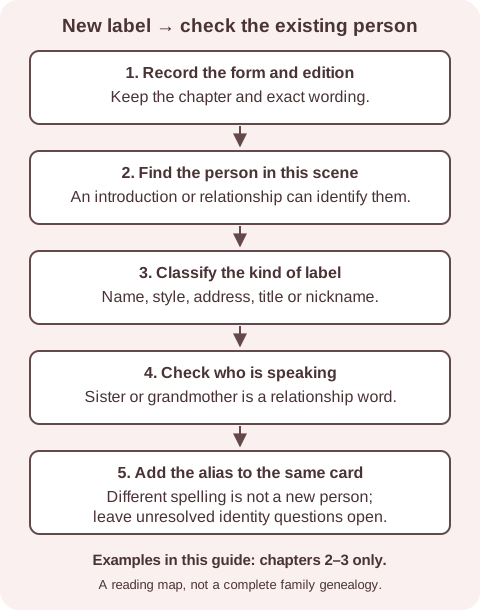
For a classroom quotation, keep your edition's exact wording, translator and page reference. Use this guide for identification, then return to the assigned text. Do not silently replace a quotation with our reference spelling and still present it as your translator's sentence.
Four worked readings from the opening naming scenes
These are explanations of the cited chapter passages, not invented scenes or quotations from an unspecified modern translation.
1. Lin Hai and Lin Ruhai: name versus style
Chapter 2 explicitly supplies surname Lin, name Hai and style Ruhai. The narrator's usual Lin Ruhai label therefore does not mean that “Ru” is an English-style middle name.
Card: Lin-family father; personal name Hai; style Ruhai; chapter 2 introduction. Keep both forms under the same person.
The distinction is stated in the chapter, so it is stronger evidence than a general assumption about all two-syllable names.
2. Daiyu calls Xifeng sao: check the cousin route
Chapter 3 identifies Xifeng as the wife of Jia Lian, the son of Daiyu's maternal uncle Jia She. Daiyu's 嫂 address fits that extended relationship.
Card: Wang Xifeng; Jia Lian's wife; identified as 璉嫂子 and addressed with 嫂 by Daiyu in their first greeting.
Do not create an otherwise unmentioned brother for Daiyu merely to make an English “sister-in-law” label fit a narrower family definition.
3. Pinpin is offered during a conversation
Baoyu asks Daiyu about a style; she replies that she has none. He then proposes 顰顰, and Tanchun challenges the cited explanation. Preserve that sequence rather than presenting the label as a separately documented formal naming ceremony.
Card: Lin Daiyu; Pinpin is a style offered by Baoyu in the chapter 3 exchange. Keep the speaker and scene beside the label.
Baoyu's book citation is part of their dialogue. This guide does not authenticate the supposed reference as an independently checked historical source.
4. Xiren and Zhenzhu: one servant's name history
The chapter 3 narration says that Xiren was previously called Zhenzhu, gives her Hua surname, and explains the naming connection Baoyu made with a poetic phrase.
Card: Xiren; Hua surname; earlier name Zhenzhu; chapter 3 servant and renaming explanation.
The narration connects those labels to one person. Its poetry reference is evidence of what the narrative says about the renaming, not a separately verified attribution to a named poet.
Keep an edition-specific card rather than a universal glossary
Put the reference identity at the top of the card, then add the forms actually used in your edition. Keep chapter or page references beside each label. Add a short relation only when the passage establishes it; a shared surname or a familiar address is insufficient on its own.
When comparing two copies, align the scene before comparing words. The inspected Joly and Wikisource chapter 3 passages do not give identical details in the allocation of Daiyu's attendants. This guide does not equate Tzu Chuan and Ying Ko or rewrite one text from the other. If your staff list differs, consult the edition and its notes rather than solving the discrepancy solely by matching sounds.
A practical reading note can be brief: “Same woman: Xifeng; narrator gives her school name; relatives explain Lian connection; grandmother uses a joke label.” That note helps you continue reading without memorizing every later alias in a whole-novel character index.
If you need the family relationships rather than a label's function, use the chapter-limited family tree linked below. If you need residence and branch, use the Rongguo/Ningguo guide. A name card records identification in a passage; it does not replace either of those broader maps.
Copy the cards and check six common name mistakes
Use the first card while reading one edition. Use the second when you are actually comparing a corresponding scene. Leave unresolved fields open rather than completing the card from a spoiler-heavy character database.
RED CHAMBER — NAME AND ADDRESS CARD
Edition / translator / chapter:
Exact form used in this passage:
Chinese form, if checked:
Person it refers to:
Personal name / style / kinship address / household title / nickname:
Who uses the form, and to whom:
Relationship established by the chapter:
Short passage or page reference:
What the label adds in this scene:
What remains uncertain:
Keep aliases under one person; do not invent a missing given name.
RED CHAMBER — TWO-EDITION LABEL CHECK
Same chapter and corresponding scene:
Edition A / translator / exact label:
Edition B / translator / exact label:
Chinese reading text and edition, if checked:
Same referent established by context:
Different spelling / translated title / translated nickname / text variant:
Relationship information each wording preserves:
Short quotation and page or paragraph reference:
Difference still unresolved:
Do not use a spelling difference alone to add a new character.
Download two cards, three reference tables and six explained cases. The examples retain their chapters 2–3 scope.
Case 1
Chapter 2 gives Lin's personal name as Hai and his style as Ruhai. Should your list contain two separate fathers for Daiyu?
Show answer and explanation for case 1
No. Keep Hai and Ruhai under the same person.
The passage explicitly distinguishes personal name and style. The same-person connection is established by that introduction, not guessed from similar sounds.
Case 2
Daiyu addresses Xifeng with sao after relatives identify her as the Lian sister-in-law. Does this prove Daiyu has a biological brother married to Xifeng?
Show answer and explanation for case 2
No. Follow the extended relationship stated in the chapter.
Xifeng is the wife of Jia Lian, the son of Daiyu's maternal uncle Jia She. The address must be read with that cousin connection rather than forcing a narrower English family-tree assumption.
Case 3
Lady Wang and Wang Xifeng share Wang in their labels. Are they the same woman?
Show answer and explanation for case 3
No. The chapter identifies different roles and shows them speaking to each other.
Lady Wang is Baoyu's mother and Xifeng's aunt; Xifeng is Jia Lian's wife. A shared surname does not merge their identities.
Case 4
An older translation writes Wang Hsi-feng while this guide writes Wang Xifeng. Should you add another character because the spellings differ?
Show answer and explanation for case 4
No. Compare the same introduction and referent first.
The inspected Joly passage gives Wang Hsi-feng as the school name of Jia Lian's wife. The reference pinyin and older spelling are different forms for the same identified name.
Case 5
Baoyu proposes Pinpin after Daiyu says she has no style. Can you describe it as an independently verified formal naming ceremony?
Show answer and explanation for case 5
No. Describe the style offered in that chapter 3 conversation.
The passage gives a proposal and exchange, including Tanchun's challenge. It does not justify importing a universal ceremony or authenticating Baoyu's book citation as a checked historical source.
Case 6
The chapter says Xiren was previously named Zhenzhu. Should both names be counted as separate servants?
Show answer and explanation for case 6
No. Record the earlier name under Xiren's card.
The narration explicitly connects the former name, Hua surname and renaming explanation to the same servant. Keep other edition differences separate rather than treating every unfamiliar spelling as another person.
Sources and further reading
- Wikisource: 紅樓夢, chapter 2Full reading text: Lin Hai/style Ruhai distinction and initial Jia family identities; variant notes preserved, no universal naming rule inferred.
- Wikisource: 紅樓夢, chapter 3Full reading text: household introductions, Xifeng's labels, Daiyu/Baoyu naming exchange and Xiren's prior name. Examples restricted to this chapter.
- H. Bencraft Joly: Hung Lou Meng, Book I, via Project GutenbergBook header and selected chapter 2–3 naming passages compared. Older spellings and brief translated labels; whole book not claimed read.
- Project Gutenberg: catalogue record for Book I, ebook 9603Verified title, English language and H. Bencraft Joly translator record. Automatically generated summary not used as historical evidence.