Dream of the Red Chamber Chapter 1 Reading Guide and Analysis
Revised · Chapter-limited literary guide
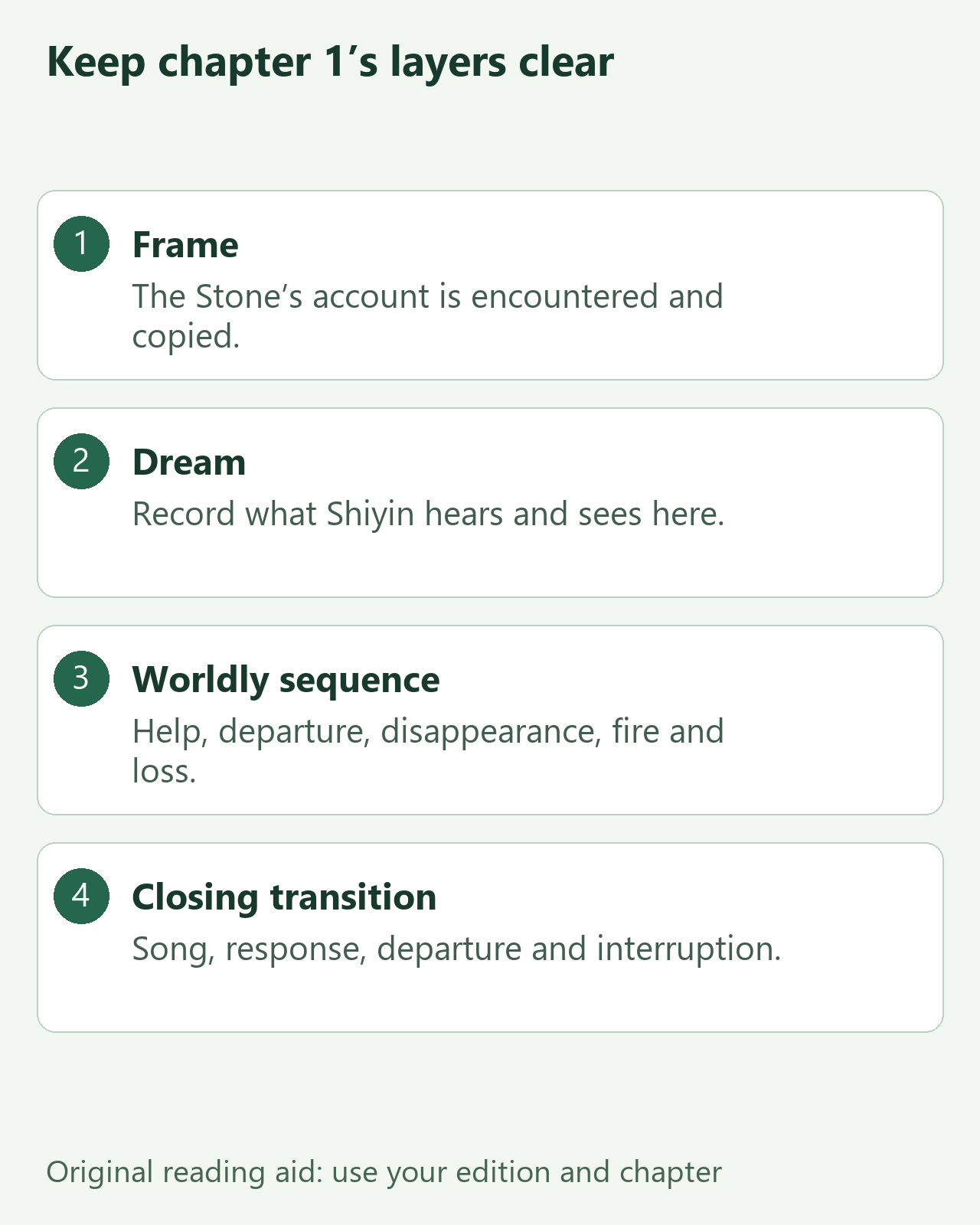
Chapter 1 moves through a story about a Stone, a dream and Zhen Shiyin’s worldly life. Follow those layers separately. The opening asks how stories, desire, help and loss are connected before it introduces the main Jia household.
Reading scope: Detailed chapter 1 events only. Later human identities, marriages and outcomes are not disclosed.
Chapter 1 in brief
An unused Stone wishes to enter the human world. Its eventual account is encountered and copied by a Daoist, giving the novel a story about the transmission of a story. The action then turns to Zhen Shiyin, who dreams of a conversation about supernatural beings entering worldly life. On waking, he encounters warnings that he cannot fully understand. [1]
Shiyin helps the impoverished scholar Jia Yucun travel to pursue his prospects. Shiyin’s daughter disappears during the Lantern Festival, and a later fire destroys his home. Further hardship follows. When Shiyin meets a Daoist singing the Haoliao song, he supplies an interpretation and leaves with him. The chapter closes with an interruption at the home his wife now occupies, carrying the reader toward chapter 2.
Spoiler scope: this page gives the events of chapter 1, including its ending. It does not reveal later identities or how the opening’s supernatural connections unfold. The summary follows the linked Chinese working text. Your edition may use different romanization or explanatory notes.
The Stone frame: how the account reaches a reader
The opening places the Stone among the material prepared for repairing the sky. It is left unused and desires the experience of worldly life. A monk and a Daoist speak with it; it is reduced to an object that can be carried. This establishes longing and transformation before the ordinary social story begins. [1]
Keep this pair separate from the Daoist who later encounters the Stone’s recorded account. The latter is called Kongkong Daoren in the Chinese text. His reading and copying form another step in the account’s transmission. The text associates a change in his understanding with a change of name. A reader who merges all these figures loses the distinction between arranging an entry into the world and encountering its written record.
The frame makes the novel’s account something presented, transmitted and given titles. It does not ask you to treat every sentence as the unmediated testimony of one stable historical narrator. Record who sees the writing, who comments on it and who passes it on. That small record is enough to follow the frame on a first reading.
A useful interpretation is that the opening draws attention to how a story becomes available and how it should be approached. That is an interpretation of the frame’s arrangement, not proof of every event’s historical accuracy. The online working text also includes editorial material. Do not turn an editorial note into something spoken by a character.
Zhen Shiyin’s dream: a connection is described, not fully explained
Shiyin’s dream introduces a conversation concerning the Divine Attendant and the Crimson Pearl’s debt of tears. The Stone is brought along with beings entering worldly life. These connections invite a reader to watch for later echoes, but chapter 1 does not require a completed chart of later human counterparts. [1]
In particular, do not automatically collapse the Stone and the Divine Attendant into one uncomplicated identity. Keep their separate mentions in your note. The relation between the supernatural account, the carried jade and later human characters can be approached as the novel develops and with attention to the chosen edition.
Shiyin sees the jade with the inscription 通靈寶玉, which can be recorded here as the inscribed object. Encountering the word Baoyu on an object is different from receiving the worldly boy’s full introduction. A first-time reader can write “jade seen in dream” without declaring that a later household scene has already occurred.
The dream also brings Shiyin toward a gateway where opposing ideas about truth and falsehood appear together. You can notice that the opening invites uncertainty about categories without deciding that nothing matters or that every worldly event is only an illusion. The following scenes give concrete consequences to help, departure, disappearance and loss.
Warnings, Jia Yucun and the help before departure
After waking, Shiyin encounters the monk and Daoist in worldly surroundings and hears a warning concerning his daughter. He does not act with the complete understanding a reader may be tempted to assign retrospectively. Keep “warning is given” separate from “warning is understood” in an event record. [1]
Jia Yucun is the poor scholar associated with Shiyin’s hospitality. The two men are not alternative names for one person. They occupy different positions in an exchange: Yucun needs resources to leave, and Shiyin is able to help. Their names participate in the novel’s play with meaning, but a name pattern does not merge their actions.
The episode involving the maid Jiaoxing is also a useful perspective check. Yucun interprets her glances in a particular way. Record that as his interpretation, rather than assuming that a glance independently proves a fully declared intention. The reader receives an encounter through narration and inference, not a modern transcript of everyone’s private explanation.
During the Mid-Autumn gathering, Shiyin offers Yucun fifty taels and winter clothes for his journey. Yucun departs early rather than waiting for the proposed auspicious day. The concrete help makes the transition possible. You do not need a modern currency conversion to understand that money and clothing answer the immediate obstacle to travel.
The losses are a sequence, not one festival disaster
During the Lantern Festival, Shiyin’s daughter is taken out by a servant and disappears after the servant leaves her unattended. This is one event. A later fire originating at the nearby temple destroys Shiyin’s home; the working chapter dates that fire to the fifteenth day of the third month. Do not combine the disappearance and fire into one evening merely because both occur in the opening chapter. [1]
Shiyin’s subsequent attempts to rebuild his circumstances do not produce an easy recovery. The narration follows the effects of loss, the sale or failure of property arrangements and his dependence on his father-in-law’s household. Its movement is from a settled household toward reduced security, not simply from one plot point to an unrelated moral statement.
A summary should state the narrated losses before proposing their significance. “The household loses a child and later its home” is an observation. “The sequence makes worldly security appear vulnerable” is an interpretation. The second statement becomes stronger when the first remains visible.
Avoid importing the daughter’s later identity, the outcome of another chapter or an explanation of everyone’s fate into this account. Chapter 1 gives a disappearance and a family’s responses to it. A first-time reader can carry the unresolved question forward.
The Haoliao song and Shiyin’s response
Shiyin encounters a Daoist singing the Haoliao song, 好了歌. The song brings worldly attachments alongside their ending or incompleteness. Shiyin then gives an extended interpretation. Keep the singer’s words and Shiyin’s response as two related voices, rather than attributing both passages to one unnamed speaker. [1]
The relation between 好 and 了 matters to the exchange; translations may handle the title and wordplay differently. Use your edition’s rendering and its note if provided. This page does not substitute a copied modern translation for the passage or claim that one English title exhausts its meaning.
Shiyin’s response leads into his leaving with the Daoist. One supported reading connects this departure with the preceding losses and the opening’s interest in worldly desire. Another might emphasize the sudden shift in the way Shiyin understands what he hears. Either argument should identify the song, his response and the narrated departure as separate anchors.
His wife’s circumstances continue after he leaves. The chapter describes her work with the remaining maids before a new official’s arrival and the closing interruption. Her continuation prevents a reader from treating Shiyin’s departure as a complete account of what happens to the household.
Why the chapter ends with an interruption
The chapter’s close presents a new official, recognition by a servant and a summons or interruption at the home. It directs attention toward what comes next. Explain the scene as a transition, then stop where the chapter stops. Giving the next chapter’s resolution would obscure how the opening makes the reader continue. [1]
At this point, you can answer three practical questions: which account belongs to the frame, what Shiyin sees or hears in a dream, and what happens to his worldly household. You do not yet need to explain the entire Jia family or every symbolic correspondence.
This site’s chapter-guide sequence currently covers chapters 1–15. That is the coverage of these guides, not the length of the novel. This page treats chapter 1. Continue in your full edition and use the opening-chapters questions when you want a bounded check of your reading.
An event map for a first reading
Read across this map in order. Its “question to keep open” column is deliberately incomplete: it preserves the uncertainties that chapter 1 gives a reader.
On a narrow screen, scroll the table sideways to read all columns.
| Layer or event | What is established here | Question to keep open |
|---|---|---|
| Stone frame | Desire for worldly experience; an account encountered and copied | How will the frame affect the story’s presentation? |
| Shiyin’s dream | A supernatural conversation and an inscribed jade | How will these connections develop in later scenes? |
| Warning and hospitality | A warning is heard; Yucun receives practical help | What does each person understand at this point? |
| Departure | Yucun leaves after Shiyin provides funds and clothing | What follows the departure beyond this chapter? |
| Worldly losses | The child disappears; a later fire destroys the home | How are these losses narrated and answered? |
| Song and response | A Daoist sings; Shiyin interprets and leaves | How do the different voices relate to his circumstances? |
| Closing interruption | The wife’s household encounters a new official’s arrival | What will chapter 2 disclose? |
For a discussion paragraph, select two connected rows. Explain their relation without collapsing them. For example, practical help makes Yucun’s departure possible, while the later loss of Shiyin’s home changes the position of the benefactor. This comparison is more specific than saying that the chapter is “about fate.”
Use sources for the right question
The Chinese working chapter supports the event sequence and the distinctions between voices described above. It contains editorial and variant material, so verify an exact quotation in your assigned edition before using it in an essay. An edition’s page numbers are more useful for that purpose than this page’s section numbers.
Project Gutenberg’s catalog identifies H. Bencraft Joly as the translator of its Book I edition. That catalog establishes which translation is being offered; its automatically generated plot description is not used here as evidence for chapter 1’s events. Book I should not be mistaken for a modern complete-novel edition solely because it can be downloaded as one file. [2]
If your main obstacle is a title or name, use the cross-novel names guide. If it is the early family introductions after this chapter, use the family reading path. Neither requires resolving all the opening’s symbolic questions before proceeding.
Worked reading examples
Each example shows how to check a reading claim against the stated chapter or passage.
“Baoyu” appears before the boy’s household introduction
A reader assumes the chapter has already introduced Jia Baoyu because an inscription uses the word. Keep the object in its actual scene: Shiyin sees the inscribed jade in his dream. Write “object and inscription” in the event note. A later worldly character introduction is a separate event. This preserves the opening’s connection without claiming that every identity question has been settled.
Two disasters become one in a short summary
Your draft says the family loses its daughter and home at the Lantern Festival. Reopen the sequence. The disappearance occurs at the festival, while the temple fire is narrated later and given a third-month date in the working text. Split the sentence into two events. The change makes the household’s worsening circumstances easier to follow and prevents an invented simultaneous catastrophe.
A reported inference becomes certain intention
A note says Jiaoxing has explicitly promised Yucun a relationship through her glance. The passage instead lets you examine how he interprets what he sees. Write “Yucun takes the glance to mean…” and locate the moment. You can discuss the force of that interpretation without turning it into a direct declaration by another character.
The song is attributed to the wrong speaker
You copy lines from the singing and the following explanation under one heading. Separate the Daoist’s song from Shiyin’s interpretive response. Then describe how the exchange leads to his departure. The two voices can be related in an argument, but maintaining their attribution makes the argument testable against your edition.
Chapter 1 event and voice card
Use this optional text record to keep an edition, passage, observation and interpretation together. Leave unconfirmed information open. Downloading the blank record does not send your completed notes to this site.
Frequently asked questions
Who are Zhen Shiyin and Jia Yucun?
They are different people in the opening worldly narrative. Shiyin provides hospitality and resources; Yucun is the impoverished scholar he helps to depart. Wordplay involving their names does not make their roles or actions identical.
Is the Stone simply the Divine Attendant under another name?
Do not assume a simple identity from chapter 1 alone. Keep the Stone, the carried jade and the Divine Attendant’s account in separate notes as they are mentioned. Later development and edition-specific explanation can inform a more careful discussion.
Can I skip chapter 1 and start with the family introductions?
Reading chapter 1 gives you the frame, the dream and a sequence of worldly help and loss that shape the opening. If it feels difficult, use the event map and continue without resolving every symbolic connection. You can return to the frame after reading further.
Does the guide explain what happens after the closing interruption?
No. It describes the chapter 1 transition and leaves the resolution to chapter 2. Later identities and outcomes are also outside this page’s scope. This keeps the summary useful during a first reading.
Choose the next reading task
Sources and what they support
- Dream of the Red Chamber, chapter 1
Chapter coverage: Stone frame, dream, hospitality, departure, disappearance, fire, song and closing transition. Editorial material is kept distinct from character speech.
- Project Gutenberg: Joly’s Dream of the Red Chamber, Book I catalog
Bibliographic identification of the translator and Book I. Its automatically generated plot summary is not used as evidence for chapter events.
This guide offers a chapter-limited literary reading. Check exact quotations and variant wording in your chosen edition.