Practice worksheet
Reading Poetry in Dream of the Red Chamber: Speaker, Image and Context
Five short passages and original translations show how to distinguish a poetic voice, an image and its scene. Check eight answers, then use the editable passage card with your own edition. Spoiler scope: chapters 1 and 3.
Read the voice before decoding the image
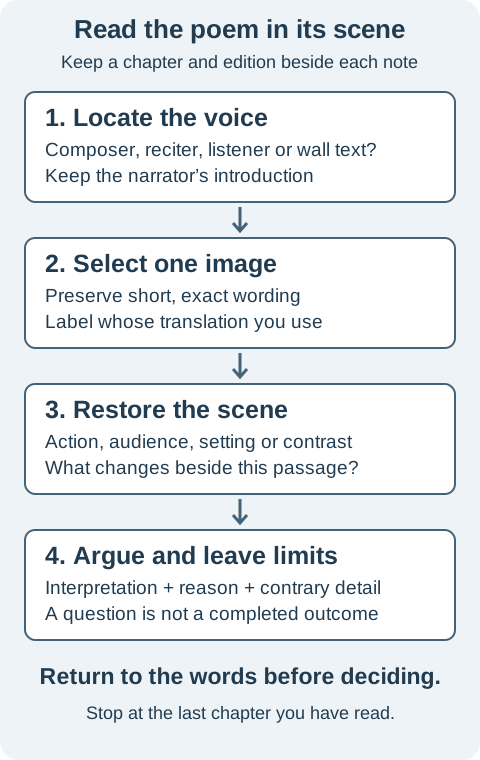
To read a poem in Dream of the Red Chamber, first identify how it enters the story. Is a character composing it, reciting another person’s lines, hearing a song, or looking at an inscription? Then record one image and the action or judgment beside it. This prevents an attractive quotation from becoming a claim the scene does not support.
This practice page uses short passages from chapters 1 and 3 only. It discusses the opening transmission frame, Yucun’s gathering with Shiyin, the Daoist’s song, Daiyu’s arrival and the verses judging Baoyu. It leaves later outcomes and the chapter 5 dream verses unexplained. Complete the relevant chapter before opening its example.
The Chinese anchors are from the linked Wikisource reading text. Every English rendering labelled “Our translation” is our own short translation, rather than wording copied from a modern English edition. Interpretive notes are also original. The downloadable card helps you repeat the method with your own edition.
The chapter 1–10 questions examine narrative knowledge, household access and judgments across whole scenes. Here the task is narrower: inspect the source of a poetic voice, the wording of an image and its immediate context.
Keep four fields beside one short quotation
| Field | What to record | Question to ask |
|---|---|---|
| Voice | The narrator’s introduction and who actually speaks, writes or displays the passage. | Does the text establish composition, recitation or an attributed voice? |
| Image | One exact word or brief phrase; keep uncertain vocabulary marked. | What does the wording compare, repeat, animate or contrast? |
| Context | The action, listener, location or preceding judgment. | What changes if I put the line back into that scene? |
| Interpretation and limit | An argued reading, a contrary detail and what remains unknown. | Have I turned a metaphor, attributed judgment or question into a factual outcome? |
A close reading can be three sentences long. Identify the voice, explain one effect of the wording, and connect it to one nearby detail. You do not need to decipher every historical allusion before making a supported observation.
Leave room for disagreement. Two readers may emphasize different effects of the same image. Both should identify the passage and account for details that resist their interpretation. A list of fixed meanings such as “jade always means purity” cannot replace that work.
Chapter 1: a verse inside the story’s transmission frame
In the opening account of how the text is transmitted and renamed, the narration says that Cao Xueqin reviewed and revised it and supplied a quatrain. Locate that introduction before reading the verse. This is a statement inside the novel’s frame; the passage alone is not independent biographical verification. [1]
滿紙荒唐言,一把辛酸淚!
都云作者痴,誰解其中味?Our translation: A pageful of absurd words, a handful of bitter tears!
All say the author is foolish—who understands the taste within?
Voice: a verse presented as supplied by the named reviser in the transmission account. Image: written words are placed beside tears, while “taste” asks about an experience that an outside verdict may miss. Context: the framing account is already concerned with how a story becomes a text that others read.
One supported interpretation is that the verse asks readers to hesitate before dismissing apparently absurd material. The final question creates a difference between a public judgment of the author and an understanding of what the writing contains. That is a reading of the contrast, not proof that every event is autobiography.
Our rendering keeps “taste” visible because it gives you a word to discuss. An English edition may choose another expression for 味. Compare its effect, but identify the translator and passage before claiming the wording is identical.
Try it: explain how the question changes the two exclamatory lines. An answer such as “the author is sad” names a mood; an answer that connects tears, dismissal and the question shows how the verse produces that mood.
Chapter 1: do not turn recitation into authorship
At the Mid-Autumn gathering, Jia Yucun is presented as making verse. Elsewhere in the encounter, however, he describes a couplet as an occasional recitation of earlier people’s lines: 偶吟前人之句. Those introductions do different work. The fact that the same character voices two passages does not establish that he composed both. [1]
玉在匵中求善价,釵於奩內待時飛。
Our translation: Jade in its box seeks a good price;
a hairpin in its casket waits for the time to fly.
Use this distinction before analysing an image. Write “Yucun recites” when that is what the narration and dialogue establish. You can still discuss why those words fit his wish for recognition, but do not add a named original poet that the inspected passage does not supply. The online note explains 匵 as another form of 櫝; the short quotation keeps the inspected form.
Put the scene’s introduction beside the image. Does the waiting object suggest unrecognized value to you? Which details of Yucun’s circumstances support that reading? Keep the claim at that level instead of identifying the image as a guaranteed prediction of his entire career.
An edition note may identify an earlier source or discuss a textual variant. Add that information with its credit. A reader’s inference about why Yucun chooses the line and a note establishing its literary source belong in separate fields.
Chapter 1: separate the Daoist’s song from Shiyin’s explanation
Near the end of chapter 1, a limping Daoist sings about people’s attachments. Shiyin asks about the relation of 好 and 了, and the Daoist names the song. Shiyin then offers an explanation in verse. Keep the singer and the explanatory speaker distinct. [1]
古今將相在何方,荒冢一堆草沒了。
Our translation: Where are the generals and ministers of old and now?
A mound of weeds has covered their desolate graves.
Voice: the Daoist’s song. Image: grand public rank gives way to a grave covered in grass. Context: the song arrives after the losses and hardships already narrated in Shiyin’s chapter. The scene makes the contrast more pointed than it would be as a decorative proverb on its own.
You might read the question and the covered graves as a challenge to the permanence of worldly achievement. Support that interpretation with the contrast in the lines. Do not call it a statement that every particular official in the novel meets an identical fate.
Now compare the function of Shiyin’s response: he elaborates the song’s reversals, and the Daoist approves the explanation. The scene supplies that response and approval. Whether you see a broader spiritual transformation should be an argued reading of the sequence, rather than a claim to know a reader’s spiritual condition.
The Chinese title 好了歌 involves the exchange about “good” and “finished” or “ended.” English titles and explanations can make different choices. Keep the Chinese title or your edition’s title beside the note rather than expecting one English phrase to preserve every effect.
Chapter 3: read the displayed couplet as part of the room
During Daiyu’s arrival, the Rongxi Hall description includes a displayed couplet. A dedication below it supplies a name and a handwriting credit. A wall inscription is not the same thing as a character speaking in the scene, and a handwriting credit alone should not be expanded into proof of composition. [2]
座上珠璣昭日月,堂前黼黻煥煙霞。
Our translation: Pearls and jade among the seats shine like sun and moon;
embroidered robes before the hall glow like mist and rosy clouds.
Voice: displayed language in a household’s formal space. Image: valuables and decorated robes are matched with brilliant celestial and atmospheric imagery. Context: Daiyu is encountering the household’s rooms, visible signs of standing and rules of reception.
Our translation makes the imagery available for comparison; it is not an inventory proving that literal jewels sat on every chair. One reading is that the couplet participates in the room’s presentation of distinction. Test that against the surrounding description and Daiyu’s cautious attention to her new setting.
A strong note can distinguish effect from speaker intention: “the displayed wording contributes to an imposing presentation” does not claim that Jia Zheng personally says the couplet to intimidate Daiyu. The passage does not narrate such a conversation.
If an edition explains 黼黻 or the dedicatory wording, record that note separately. Do not invent a precise historical dress regulation from this short translation.
Chapter 3: verses about Baoyu are not poems by Baoyu
The narration introduces two 西江月 lyrics as later people’s apt criticism of Baoyu: 後人有《西江月》二詞,批寶玉极恰. Keep that introduction attached to the words. Baoyu is their subject; the passage does not present him composing or reciting them. [2]
富貴不知樂業,貧窮難耐凄涼。
Our translation: In wealth, he does not know how to attend gladly to his work;
in poverty, he can hardly bear desolation.
Voice: a critical verse attributed within the narration. Image and structure: wealth and poverty form a pointed contrast, with dissatisfaction attached to both. Context: the lyrics sit among the introduction of Baoyu and the competing impressions of him.
Start by describing the standard the criticism applies. It measures him against an expectation of useful conduct and suitability to circumstance. Then ask how the surrounding scene affects your response: does it confirm the verdict, complicate it, or allow an ironic distance? A claim of irony needs reasons from the passage, not merely the assurance that criticism must mean praise.
Avoid converting the lyrics into a clinical description. Poetic insults and moral judgments are language used by the narrative; they do not establish a medical condition. Nor does this contrast, on its own, report two completed episodes in which Baoyu has already lived first wealthy and then poor.
As a final check, write the sentence with attribution: “The critical lyric presents Baoyu as…” You can subsequently argue with that presentation. This preserves a distinction that disappears in “Baoyu says he…”
Eight checks before sharing your reading
These original checks use the chapter 1 and 3 examples above. Answer first, then open the explanation. They test attribution and reasoning, rather than demand a single verdict about the whole novel.
Case 1
A reader calls the framing quatrain independent proof that every event happened to Cao Xueqin. What should change?
Show answer and explanation for case 1
Keep the novel’s transmission account separate from external biography.
The passage attributes a verse within that frame. The words-and-tears contrast can support interpretation without verifying a life history.
Case 2
Yucun says he is reciting earlier people’s lines. Can the notebook label him their composer?
Show answer and explanation for case 2
No: record him as the reciter unless a source establishes composition.
The introduction supplies a different act. A suggested fit with his ambitions is an interpretation of use, not authorship.
Case 3
A quotation combines the Daoist’s song and Shiyin’s later explanation under one speaker. How should it be repaired?
Show answer and explanation for case 3
Separate the song from the explanatory response and identify each speaker.
The chapter stages a conversation, an explanation and approval. Combining the voices loses that sequence.
Case 4
Does the grave imagery prove every named official’s later outcome?
Show answer and explanation for case 4
No. Explain the contrast between rank and impermanence without assigning individual outcomes.
A general poetic question does not narrate every person’s future. This page stops at chapters 1 and 3.
Case 5
Can the Rongxi Hall couplet be quoted as Jia Zheng’s spoken welcome to Daiyu?
Show answer and explanation for case 5
No. It is displayed wording encountered in the room description.
The text does not narrate that speech. Handwriting credit also needs to be kept distinct from composition.
Case 6
Is the wealth-and-poverty lyric a self-description composed by Baoyu?
Show answer and explanation for case 6
No. The narration introduces critical lyrics about him.
The subject of a poem and its attributed voice are different fields. Keep the introduction beside the quotation.
Case 7
A reader claims the criticism is ironic but cites no nearby detail. What would strengthen the answer?
Show answer and explanation for case 7
Identify the critical standard, then explain a surrounding detail that complicates it.
Irony is an interpretation to argue. It is not established merely by labelling a negative sentence ironic.
Case 8
Your translation differs from this page’s rendering of 味. Must one be an inaccurate quotation?
Show answer and explanation for case 8
First identify whose translation each English phrase is.
Both may be translation choices. Compare the Chinese anchor and effects; do not present our own wording as a published translator’s quotation.
Make a note you can revise in your own edition
For the displayed couplet, a compact first note might read: “The verse is encountered on the wall during Daiyu’s arrival. Its brilliant comparisons contribute to the room’s presentation of standing. This does not establish that the host speaks the words or that the imagery records literal objects on each seat.” That paragraph joins voice, image and context while retaining a limit.
RED CHAMBER — ONE POETIC PASSAGE
Last chapter read / spoiler limit:
Edition, translator and volume:
Chapter, page or other location:
Short wording exactly as printed:
Who writes, recites, hears or displays it?
How does the narration introduce that voice?
Composer identified / attributed / not established:
English wording: my translation / named translator / paraphrase:
One image and its literal wording:
An action, setting or contrast beside the passage:
My interpretation, with a reason:
An alternative interpretation or contrary detail:
What the passage does not establish:
Word or allusion to check in an edition note:
Revision after checking, keeping the first note:
Stop at the last chapter actually read.
Download the poetic-passage card and eight explained checks (TXT). The file includes these same short Chinese anchors and our translation labels; it does not contain a full chapter or a modern translator’s copyrighted poem.
The linked reading text contains editorial notes and variants. Chapter 1 notes that introductory commentary paragraphs can be mixed into the body; chapter 3 records variant wording. This guide uses an annotated online working text, not a diplomatic transcription of one historical manuscript. Record your own edition and page, and revisit a difference through that edition’s notes.
If a line remains difficult, circle one word, keep an initial paraphrase and move forward. Return when you have a concrete question. For a broader scene-based argument involving chapter 27, the poetry and characterization guide has a later spoiler boundary. Open it only after that chapter. The time and seasons worksheet handles literal timing separately from poetic seasons.
Sources and further reading
- Wikisource: 紅樓夢, chapter 1Complete inspected working text and notes: transmission quatrain, composition versus recitation, Daoist song and Shiyin response. Short Chinese anchors and our own English renderings.
- Wikisource: 紅樓夢, chapter 3Complete inspected working text and variant notes: Rongxi Hall wall inscription and critical 西江月 lyrics about Baoyu; narrated introductions checked.