Practice worksheet
Dream of the Red Chamber Chapters 1–10: Reading Questions and Notes
Twenty original questions connect precise scenes to supported interpretations. Open hints after each chapter, keep later outcomes unspoiled, and record what the text establishes and leaves uncertain.
Use the questions after each chapter, before opening the hints
Read one chapter, answer its two questions with a passage in your own edition, then open the hints. These twenty questions concentrate on who knows, who interprets, who has influence and what the narrator actually establishes. You do not need to memorize every name before beginning.
Spoiler boundary: chapters 1–10 only. The page mentions encounters, the case, the dream, the school disturbance and the illness already presented in those chapters. It does not identify later fulfilments of the dream verses or reveal what happens after chapter 10. Open only the chapter you have finished.
The names here use modern pinyin: Jia Yucun, Lin Daiyu, Jia Baoyu, Xue Baochai, Wang Xifeng and Qin Keqing. Your translation may spell them differently. Locate the scene and its speakers rather than expect the same English sentence. For labels that seem to introduce another person, use the names and forms of address guide, which covers chapters 2–3.
Answer in three parts: a textual observation, your interpretation, and what remains unestablished. A short supported answer is more useful than a plot summary with an unsupported motive attached.
Chapter 1: Two glances, two perspectives
Text anchor: Locate Jiao Xing looking at the visiting Jia Yucun, before his departure for the examinations.
- What reason for looking does the narration give Jiao Xing? What does Yucun conclude from the glances?
- Why should a reading note keep those accounts separate, even if both make sense within the scene?
Show answer hints for chapter 1
Question 1: The narration presents her recognition and curiosity about the poor scholar whom her employer has mentioned. Yucun takes the repeated glances as evidence that she appreciates him. Those are different accounts of the same encounter.
Question 2: You can discuss his wish to be recognized without calling his conclusion a demonstrated fact about her. Separate “her thought is narrated” from “he interprets her glance.” A later occurrence is unnecessary to establish that difference.
Keep this boundary: Do not turn a glance into proof of a real person’s feelings, or treat the opening author-preface as uncontested autobiography.
Check the Chinese text of chapter 1. Add the page or location from your own edition to your answer.
Chapter 2: A grand building and a troubling account
Text anchor: Find Jia Yucun and Leng Zixing discussing the Jia family and the condition of its households.
- Why does Yucun think Leng’s description of decline is surprising? What evidence does each speaker use?
- How do their different evaluations of Baoyu complicate a single label such as “promising” or “spoiled”?
Show answer hints for chapter 2
Question 1: Yucun recalls imposing buildings. Leng distinguishes an outwardly impressive establishment from rising expenses, diminishing resources and failures of management. A large house is not, by itself, an account of its finances.
Question 2: Leng’s report about Baoyu and Yucun’s theory of exceptional natures are attributed judgments. Compare who tells the story, what examples they select and what explanation they favour. The passage is not an independent financial audit or a diagnosis of the boy.
Keep this boundary: Write “Leng says” when using his household assessment; do not silently promote a speaker’s account into an omniscient finding.
Check the Chinese text of chapter 2. Add the page or location from your own edition to your answer.
Chapter 3: Daiyu adjusts her answer
Text anchor: Find the grandmother’s question about Daiyu’s reading, then Baoyu’s later question on the same subject.
- How does Daiyu describe her education in the two exchanges? What remark from the grandmother comes between them?
- What makes social adjustment a plausible reading of the change, and what keeps it an interpretation?
Show answer hints for chapter 3
Question 1: She first mentions beginning the Four Books. After the grandmother minimizes the girls’ learning, Daiyu describes only a little schooling and knowledge of characters when Baoyu asks. Keep the order of speakers beside the two replies.
Question 2: The narrator has already described her caution about being judged in a new household. That supports an inference about adapting her presentation. The scene does not explicitly announce the motive for the revised answer, so “she may be adjusting to the household” is stronger reading practice than simply calling her a liar.
Keep this boundary: Use the actual exchanges in your edition. Do not infer every household member’s educational ability from the grandmother’s brief remark.
Check the Chinese text of chapter 3. Add the page or location from your own edition to your answer.
Chapter 4: A proposed scheme is not a narrated action
Text anchor: Locate the gatekeeper’s private advice to the newly appointed magistrate Jia Yucun about the murder case.
- Which parts of the gatekeeper’s scheme are proposals? What does the narration explicitly say Yucun subsequently does?
- How do the powerful-family list and Yucun’s own connections change the way the case is handled?
Show answer hints for chapter 4
Question 1: The gatekeeper proposes a deceptive account involving Xue Pan’s death and a supernatural explanation. Yucun initially questions the plan. The narration then states that he bends the law, reaches a careless judgment, arranges compensation and reports the resolution to patrons. It does not narrate every proposed device being carried out.
Question 2: The list explains which families must not be offended, while the conversation connects the magistrate’s career to those patrons. Ground an argument about compromised justice in that exchange and the narrated judgment, rather than inventing a complete legal procedure.
Keep this boundary: The resolution of the official case does not undo the victim’s harm. Keep “the case is settled” separate from “justice is done.”
Check the Chinese text of chapter 4. Add the page or location from your own edition to your answer.
Chapter 5: Seeing a warning without understanding it
Text anchor: Find Baoyu examining the dream registers, then listening to the songs in the visionary realm.
- What is placed before Baoyu, and what evidence shows that access to the material does not mean he understands it?
- How does his response to the songs differ from the Fairy’s purpose in showing them to him?
Show answer hints for chapter 5
Question 1: He encounters pictures, verses and records, yet the narration repeatedly marks his failure to understand. Record what he sees without assigning each image to a later event. Unresolved material can remain an open reading note.
Question 2: The songs affect him through their sound and mood, while he does not inquire into their underlying matter. The Fairy wants perception and explicitly laments its absence. Exposure, emotional response and understanding are therefore three different things in the scene.
Keep this boundary: No decoding of later marriages, deaths or other outcomes is required here. Our questions concern the response shown in chapter 5, not whether a later plot fulfils a prediction.
Check the Chinese text of chapter 5. Add the page or location from your own edition to your answer.
Chapter 6: A request must pass through people
Text anchor: Find Liu Laolao’s first visit, from the entrance and Mrs Zhou Rui’s help to the audience with Wang Xifeng.
- Which people and household routines affect when Liu can speak to Xifeng? What does her mistake about Ping’er reveal?
- How can you compare Xifeng’s statement about a large household’s difficulties with Liu’s view of the help she receives?
Show answer hints for chapter 6
Question 1: Gatekeepers, Mrs Zhou Rui, attendants and the timing of Xifeng’s business mediate access. Liu initially mistakes the well-dressed Ping’er for the person she seeks. The episode shows that visible elegance alone does not identify authority, and that an outsider needs help to navigate the household.
Question 2: Xifeng speaks of the demands on a large establishment; Liu regards twenty taels of silver as substantial help. An additional cash allowance is provided for the journey. Compare their stated perspectives without pretending to know a modern purchasing-power equivalent.
Keep this boundary: Explain the access sequence before judging the encounter as simply generous or humiliating. More than one reading can be supported by specific details.
Check the Chinese text of chapter 6. Add the page or location from your own edition to your answer.
Chapter 7: Flowers arrive in an order
Text anchor: Find Aunt Xue’s instructions for the twelve flowers and follow Mrs Zhou Rui’s delivery route to Daiyu.
- What accounts for the delivery sequence in the narration? What meaning does Daiyu attach to receiving the last two?
- In the later meeting, what does Baoyu envy about Qin Zhong’s circumstances, and what does Qin Zhong envy about Baoyu’s?
Show answer hints for chapter 7
Question 1: Mrs Zhou Rui follows a convenient route through the household, with other business interrupting the errand. Daiyu reads the remaining flowers as an insult. The timing of delivery is narrated; deliberate selection of inferior flowers for her is not established by that timing.
Question 2: Baoyu imagines the advantages of a less exalted home that would let him know Qin Zhong; Qin Zhong sees poverty as a barrier to closeness with Baoyu. The narration gives both inward responses. Their mutual admiration does not erase the difference in material circumstances.
Keep this boundary: Distinguish Daiyu’s interpretation from the delivery account. Do not use later events to decide what Mrs Zhou Rui secretly intended.
Check the Chinese text of chapter 7. Add the page or location from your own edition to your answer.
Chapter 8: Matching words and a changed report
Text anchor: Find the comparison of the jade and Baochai’s gold ornament, then Xiren’s response to the broken teacup later in the chapter.
- Who first says that the inscriptions form a pair? Who repeats that idea, and where is the explanation cut short?
- What happens to the teacup according to the narration? What account does Xiren give the grandmother’s messenger?
Show answer hints for chapter 8
Question 1: Ying’er first draws the comparison; Baoyu also notices the pairing. Baochai redirects the conversation while Ying’er’s account of the monk is unfinished. Record the speakers and the interruption. Matching inscriptions do not themselves establish a later marriage or prove a supernatural instruction.
Question 2: Baoyu throws the cup after hearing that his tea was given to his nurse. Xiren explains the noise as her own accidental slip while serving tea. Here the narrator gives enough information to compare an event with a protective cover story; unlike the flower errand, the accounts are explicitly different.
Keep this boundary: A character’s remarks about alcohol or medicine are part of the novel’s conversation, not practical health advice.
Check the Chinese text of chapter 8. Add the page or location from your own edition to your answer.
Chapter 9: The school has more than one purpose
Text anchor: Find Baoyu’s departure for school, Jia Zheng’s instructions, and the end of the classroom disturbance.
- How do Baoyu’s desire for companionship and Jia Zheng’s demands about study differ? What does each want school to accomplish?
- Does the final apology demonstrate an impartial investigation? Which people have leverage over how the disturbance ends?
Show answer hints for chapter 9
Question 1: Baoyu is eager to attend with Qin Zhong; Jia Zheng insists on understanding and memorizing the Four Books rather than merely performing study. Compare their stated priorities with the school’s declared purpose of educating relatives who cannot afford a tutor.
Question 2: The substitute supervisor Jia Rui has compromised authority. Li Gui intervenes, Baoyu threatens to leave and demands an apology, and Jin Rong is pressed to comply. The settlement ends the immediate disturbance but does not establish that every allegation has been examined fairly.
Keep this boundary: Keep the classroom accusations attributed to their speakers. These questions concern education, power and the settlement, without reproducing the scene’s explicit insults.
Check the Chinese text of chapter 9. Add the page or location from your own edition to your answer.
Chapter 10: An apology does not end a grievance
Text anchor: Find Jin Rong at home, his aunt’s visit to You Shi, and Zhang Youshi’s examination of Qin Keqing.
- Why does Jin Rong’s mother discourage another confrontation? How does his aunt’s purpose change after entering the Ningguo household?
- Why does Zhang ask to examine before hearing the case? What has, and has not, happened by the end of chapter 10?
Show answer hints for chapter 10
Question 1: His mother stresses the school’s meals, saved expenses and assistance obtained through connections. His aunt sets out to complain but loses that resolve while hearing about Qin Keqing’s illness and receiving courteous hospitality. The dispute has moved from the classroom into relationships of dependence.
Question 2: You Shi criticizes the usual doctors for following the household’s wording. Zhang first examines, then describes symptoms and asks for comparison with the history. That contrast makes his authority persuasive within the scene. A prescription is sent to be prepared, but its effect is left to the next chapter.
Keep this boundary: Zhang’s pulse theory, prognosis and numerical cure estimate are fictional medical claims. Do not translate them into a modern diagnosis or a reliable probability, and do not copy the prescription as a remedy.
Check the Chinese text of chapter 10. Add the page or location from your own edition to your answer.
A worked answer and a reusable reading note
Here is a compact answer to the first flower question. It makes an argument while leaving an unsupported motive unresolved. The example summarizes chapter 7 in original wording; it is not a quotation from an English translation.
| Part of the answer | Supported statement | Passage to check |
|---|---|---|
| Observation | Daiyu receives the remaining two flowers after the other deliveries. | Aunt Xue’s instructions and Mrs Zhou Rui’s route. |
| Character’s interpretation | Daiyu treats their being last as a slight. | Daiyu’s response on seeing the flowers. |
| Limit | The delivery account does not establish deliberate inferior selection for her. | The narrator’s account of convenient routing and interruptions. |
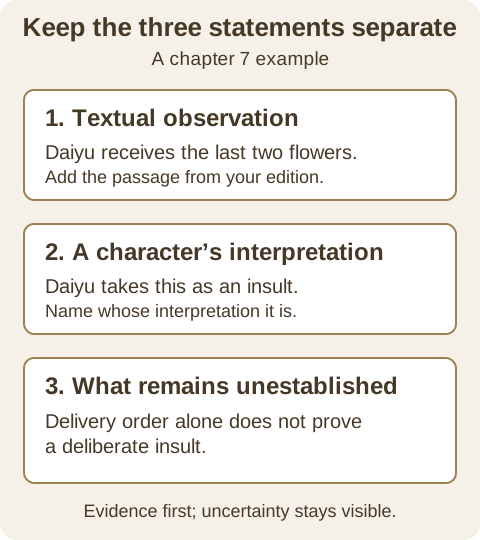
Copy the card below for any of the twenty questions. Use a brief paraphrase and a location reference, rather than reproduce a long copyrighted passage. If a word is unclear, leave it unresolved until you can check your edition’s note.
RED CHAMBER — ONE-CHAPTER READING NOTE
Chapter completed:
Edition / translator:
Question number:
Scene and speakers:
Page or location in my edition:
Textual observation, in my own words:
Whose interpretation is presented:
My supported inference:
What the passage does not establish:
An unresolved question to carry forward:
Hint checked after my first answer: yes / no:
Revision to my answer, with the original retained:
Stop at the last chapter actually read.
Download all twenty questions, answer hints and the blank note (TXT). The download has the same chapter 1–10 spoiler boundary.
After chapter 10, compare three patterns without jumping ahead
Choose one pair of scenes and write a paragraph using two locations. The purpose is to test a pattern against a second example, not to prove that the whole novel always behaves the same way.
| Scenes | Useful comparison | Avoid concluding |
|---|---|---|
| Chapters 1 and 7 | Yucun’s reading of a glance and Daiyu’s reading of a delivery order. | That a plausible motive has been independently established. |
| Chapters 3 and 8 | Daiyu’s adjusted answer and Xiren’s report about the cup. | That every changed account has the same purpose or evidential status. |
| Chapters 9 and 10 | The compelled school apology and the family’s response at home. | That an apology necessarily removes the grievance or its material pressures. |
A defensible paragraph can include a difference. In chapter 8 the narration tells you who threw the cup, so Xiren’s explanation can be compared with an established narrated event. In chapter 7 the motive behind a delivery is not similarly established. Calling both scenes “misunderstanding” without that distinction loses useful evidence.
If relationships block the comparison, consult the opening family tree or the Rongguo and Ningguo guide; both focus on opening introductions. For the last chapter’s two connected episodes, use the chapter 10 summary and reading notes.
Edition differences and the limits of these hints
The Chinese chapter pages linked here include notes recording variant chapter headings. Your English edition may choose another heading or render names and address terms differently. These questions locate actions and exchanges by chapter; they do not require one translator’s wording to be the only correct answer.
The online chapter 5 page carries an insufficient-correction notice. For the specific claim about Baoyu’s failure to grasp the registers and songs, we also checked the public-domain H. Bencraft Joly translation. Its old spellings include Pao-yü. This cross-check supports that limited point; it does not certify every line of the Chinese page or make the old translation a substitute for a modern edition.
The hints offer supported starting points, not an exhaustive answer key or a professional scholarly edition. You may disagree if you identify the passage and account for contrary evidence. Dreams, inscriptions, accusations and medical statements belong to their narrative contexts. A character’s assurance is not automatically the narrator’s assurance.
Some opening chapters include sexual material and abusive language. These original questions discuss narrative understanding, household access and institutional power without reproducing explicit passages. Readers and teachers can choose questions appropriate to their setting.
Keep your final note provisional: what changed in your understanding, which passage changed it, and which question remains open. Further reading can revise an interpretation; it need not be brought backward to spoil a first reading.
Sources and further reading
- Chinese text: Dream of the Red Chamber, chapter 1Chapter-specific scene, speaker, action and variant-heading check; original question and hint paraphrases.
- Chinese text: Dream of the Red Chamber, chapter 2Chapter-specific scene, speaker, action and variant-heading check; original question and hint paraphrases.
- Chinese text: Dream of the Red Chamber, chapter 3Chapter-specific scene, speaker, action and variant-heading check; original question and hint paraphrases.
- Chinese text: Dream of the Red Chamber, chapter 4Chapter-specific scene, speaker, action and variant-heading check; original question and hint paraphrases.
- Chinese text: Dream of the Red Chamber, chapter 5Chapter-specific scene, speaker, action and variant-heading check; original question and hint paraphrases.
- Chinese text: Dream of the Red Chamber, chapter 6Chapter-specific scene, speaker, action and variant-heading check; original question and hint paraphrases.
- Chinese text: Dream of the Red Chamber, chapter 7Chapter-specific scene, speaker, action and variant-heading check; original question and hint paraphrases.
- Chinese text: Dream of the Red Chamber, chapter 8Chapter-specific scene, speaker, action and variant-heading check; original question and hint paraphrases.
- Chinese text: Dream of the Red Chamber, chapter 9Chapter-specific scene, speaker, action and variant-heading check; original question and hint paraphrases.
- Chinese text: Dream of the Red Chamber, chapter 10Chapter-specific scene, speaker, action and variant-heading check; original question and hint paraphrases.
- H. Bencraft Joly: Hung Lou Meng, Book I, chapter VEight complete selected paragraphs cross-check Baoyu’s failure to comprehend the records and songs; not a whole-book review.
- Project Gutenberg catalogue: Joly translation, eBook 9603Translator and edition identification; the automatically generated summary is not used as scholarship.