Genealogy and Household Rank in Red Chamber
Revised · Chapter-limited literary guide
A person’s place on a family tree does not explain every household action. Read authority through the relationship, setting, request, permission and resources shown in a particular scene.
Reading scope: Relationship and household examples from chapters 2, 3 and 6. No later character outcomes or universal historical ranking system.
Household rank is more than one ladder
In Dream of the Red Chamber, generation, branch, marriage, office, residence and service can all matter to an encounter. They do not combine into one simple list from most powerful to least powerful. An elder may command deference, a younger relative may manage supplies, and a servant may control the immediate route through which a visitor reaches that manager.
This guide reads selected scenes in chapters 2, 3 and 6. It explains how to distinguish the kinds of position the novel shows, rather than reconstructing a complete legal code for Qing households. A fictional exchange can illuminate social relations, but it does not establish that every historical household followed one identical rule.
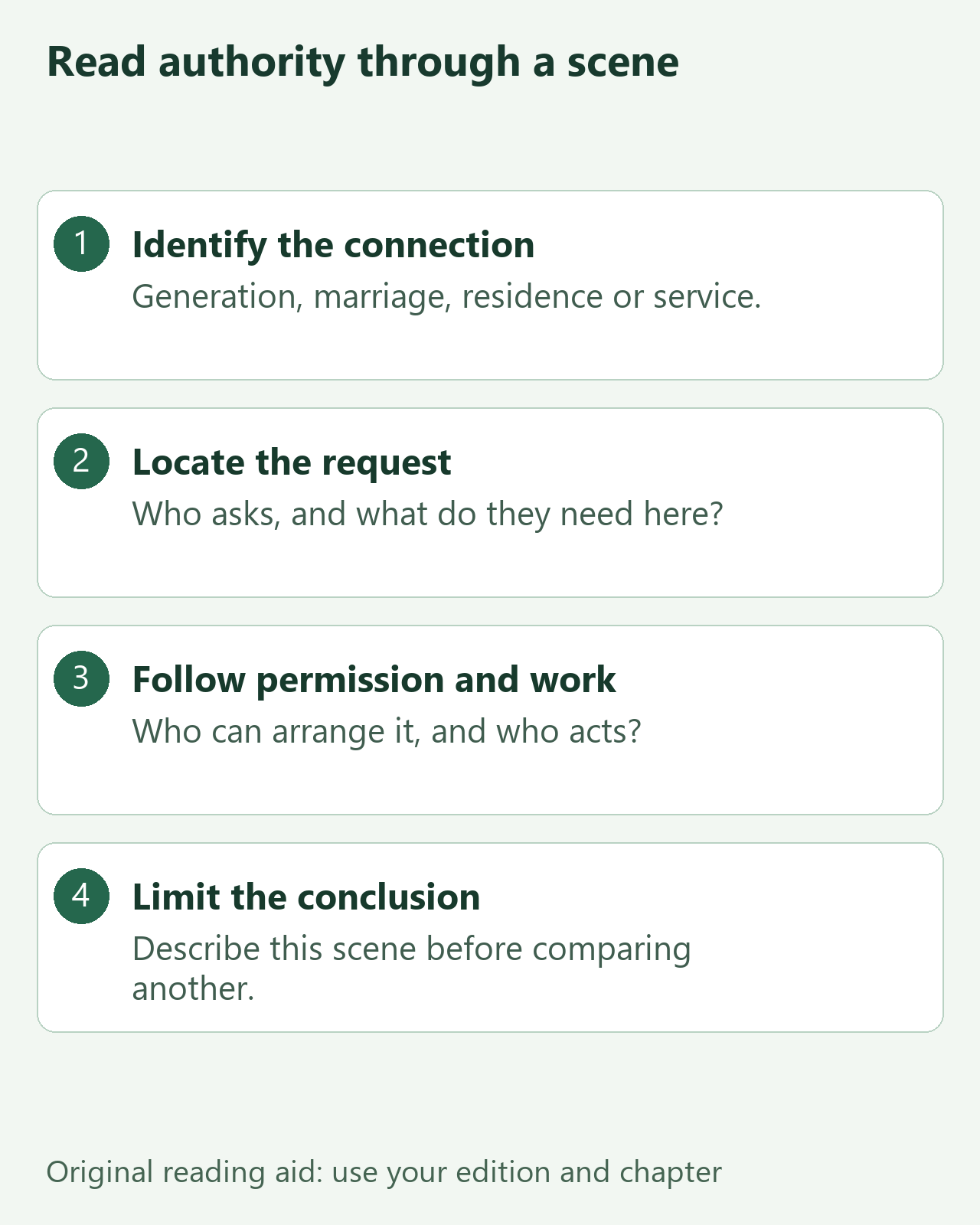
Begin with a question about an action: who can ask, who must answer, and who can make the requested thing happen? Then consult the family connection. Starting with the action prevents a title or a surname from carrying more explanatory weight than the scene supports.
Generation helps explain deference; it does not allocate every task
Grandmother Jia’s senior family position helps explain her reception of Daiyu and the attention given to her wishes. Daiyu is the daughter of Jia Min, Grandmother Jia’s daughter. This is a genealogical connection, and it matters to the arrival. [1, 2]
At the same time, the arrival chapter shows younger people carrying out service and managing practical details. You cannot infer that everyone with the same generation has the same duties, or that the oldest person personally administers each supply. The chapter’s actions distinguish ceremonial attention, daily management and the experience of a guest.
In your notes, write “senior family relationship” beside a relevant greeting and “performs this task” beside a service action. If a character speaks for another person, preserve that attribution too. A report of what an elder wants and the elder’s own statement are related evidence, but they are not identical moments.
A family branch and an official position are different fields
The family account in chapter 2 distinguishes the Rongguo and Ningguo branches and supplies information about particular men’s positions. Jia She’s inherited title and Jia Zheng’s appointment at the Ministry of Works are not the same kind of status. Record the form stated in the text rather than translating both into a generic modern “executive rank.” [1]
The Chinese working passage names Jia Zheng’s office as 工部員外郎. A translation may explain that office in its own terms. Its appearance tells you something about the character’s public position; it does not mean that he personally supervises every meal, greeting or visitor in the household.
Branch identifies a family connection. Office identifies a public appointment or title. Presence identifies whether the person is actually in the scene. Keeping these three fields separate is particularly helpful when a conversation describes someone who has not appeared or when a visitor receives a message in place of a meeting.
For the two-household orientation, use the Rongguo and Ningguo guide. That guide answers where a household belongs. This page answers how a specific exchange reveals different forms of position.
Marriage connects families without replacing every relationship
Wang Xifeng is Jia Lian’s wife, and Jia Lian is Jia She’s son. Her connection with Lady Wang also matters to household business. The chapter 2 account and chapter 3 encounter give a reader different kinds of information about her: a marriage and family connection on one hand, and practical responses and tasks on the other. [1, 2]
Do not turn “Lady Wang” into another name for Xifeng because both share the surname. Likewise, a title used in address does not tell you by itself whether a person is a biological mother, an aunt or a married relative. Locate the person speaking and the relationship already established in the chapter.
Marriage may connect a character to a spouse’s household while natal-family relationships remain relevant. A clear note can therefore have two entries without contradiction: “married to Jia Lian” and “connected to Lady Wang through the Wang family.” When you need the exact relationship, verify it in the limited family diagram.
Residence and guest status do not establish parentage
Daiyu’s arrival combines close kinship with the practical situation of entering a household as a newcomer. Her connection to Grandmother Jia does not make every room, form of address or service arrangement automatically familiar to her. The reader follows what she observes and how she responds. [2]
Ask two separate questions: why is this person received here, and how does this particular encounter proceed? The first may be answered by kinship; the second may depend on guidance, courtesy, requests or the person managing the immediate arrangements. A family chart can supply the first answer while leaving the second unresolved.
Someone staying in a household should be recorded with both a relationship and a residence field. Do not draw a new parent-child connection just because a young person receives care, attention or a room. The early reading path applies that separation to the family introductions as they unfold.
Service and access: why intermediaries matter
Chapter 6 gives a particularly clear access problem. Liu Laolao wants help, but wanting to speak to a household manager is not the same as being able to walk directly into the relevant room. Zhou Rui’s wife helps carry the connection forward, and Ping’er participates in receiving and directing the visitor. [3]
The chapter describes the Wang connection as an affiliation through a shared surname rather than close, established blood kinship. This matters: Liu Laolao’s claim offers a route toward an encounter, but the claim should not be silently converted into a near-relative relationship on a genealogy.
Dress can also mislead a newcomer about identity. A well-dressed attendant is not automatically the mistress of the household. Confirm whom the narration identifies and what that person does. Ping’er’s role in the encounter is important without turning her into Xifeng or treating all servants as one undifferentiated category.
An intermediary may possess useful immediate access while remaining in service to someone else. Write “can pass the message” or “directs this visitor” when those are the actions shown. That is more precise than asserting that the intermediary has the same authority over household resources as the person she serves.
Delegated work explains authority in a particular exchange
In chapter 3, Lady Wang asks Xifeng about practical matters including an allowance and cloth. The exchange is evidence of work entrusted to her. It helps explain Xifeng’s authority more directly than a bare statement that she is forceful or married into a prominent family. [2]
Distinguish the person who gives a request, the person who can organize its fulfilment, and the people who carry out the individual tasks. The novel can place these functions in different hands. “Xifeng handles this arrangement” does not require “Xifeng is the oldest woman” or “Xifeng has unlimited control.”
Chapter 6 adds another perspective: the ability to provide assistance is experienced by a visitor whose own circumstances are much more restricted. Read the stated gift and the visitor’s responses without inventing an exact modern purchasing-power conversion. The scene can show unequal resources while leaving many household financial details unknown. [3]
For a character-focused comparison of Xifeng’s speech, resources and later delegated work, use the Wang Xifeng guide. Its later-chapter section has a separate spoiler warning. The examples on this page remain in the early encounters.
A scene table keeps the dimensions visible
Use the table to classify a detail before turning it into a claim. One action may involve more than one dimension, but the dimensions should remain distinguishable.
On a narrow screen, scroll the table sideways to read all columns.
| Dimension | Early evidence to locate | What it helps explain | What it does not establish |
|---|---|---|---|
| Generation and kinship | Grandmother Jia receives Daiyu in chapter 3 | A close family connection and attention to an elder | That the elder personally manages every task |
| Branch and office | The family account in chapter 2 | Different family branches and stated public positions | One modern rank system for all domestic exchanges |
| Marriage and natal family | Xifeng’s connections in chapters 2–3 | Why both Jia and Wang relationships matter | That a shared surname makes two women the same person |
| Guest and residence | Daiyu’s arrival in chapter 3 | Reception, guidance and a newcomer’s perspective | New biological parentage |
| Service and access | Intermediaries in Liu Laolao’s visit, chapter 6 | How a request reaches the right person | Identical authority for every servant and manager |
| Delegated work | Lady Wang’s practical questions to Xifeng, chapter 3 | Who is responsible for particular arrangements | Unlimited control outside the observed exchange |
A strong discussion sentence names the action before the interpretation: “Lady Wang asks Xifeng about a household arrangement; the exchange indicates delegated responsibility in this area.” A weaker sentence says only “Xifeng outranks everyone.” The first can be checked in the chapter; the second erases the very relationships that make the scene intelligible.
Treat forms of address as evidence of an exchange
Terms rendered as “lady,” “mistress,” “grandmother” or other kinship addresses can carry social meaning in a scene. They are not necessarily stable personal names. Note who uses the term, whom it identifies, and whether your edition retains or translates it. [2, 3]
An address may express deference, familiarity, a service relation or a speaker’s attempt to approach someone. The effect needs context. Do not assign the same force to a term across every speaker, household and novel merely because an English translation uses the same word.
The cross-novel names guide distinguishes personal names, courtesy names, titles and changing address. The early Red Chamber name card provides a narrower aid if the immediate question concerns chapters 2–3.
Write an authority snapshot, not a permanent ranking
Choose one exchange and fill in five fields: relationship, place, request, permission and material action. Then add one sentence about the limits of the evidence. For instance, observing who can arrange cloth in this scene does not reveal every later spending decision.
On a second reading, compare the snapshot with another encounter involving the same person. Does the task change? Does an elder’s presence change the exchange? Does a visitor have different access? These questions turn household structure into an account of actions rather than a list of fixed personalities.
Use the blank scene record below to preserve your edition and page reference. Your own comparison can disagree with this guide’s emphasis, provided it keeps the textual observation separate from the interpretation and identifies the passage that supports it.
Worked reading examples
Each example shows how to check a reading claim against the stated chapter or passage.
The most senior person is not doing every managerial task
Your note identifies Grandmother Jia as the elder and then attributes all practical arrangements to her. Revisit chapter 3’s exchanges. Record the elder’s reception of Daiyu separately from Lady Wang’s questions and Xifeng’s responses about household business. You can explain seniority and delegated work together without assigning every task to the same person.
A shared surname becomes an invented close relationship
Liu Laolao’s visit has a Wang connection, so a reader adds her to a close bloodline. Chapter 6 qualifies the connection as a surname affiliation. Keep that qualification beside the claim and record the intermediaries who make access possible. The revised note explains why a claimed connection matters without turning it into a biological fact.
A well-dressed attendant is mistaken for the mistress
A reader identifies the person receiving the visitor by clothing alone. Confirm the narration’s identification of Ping’er and the actions she performs in chapter 6. Note receiving, directing and access as her functions here. Those functions are significant, but they do not make her Xifeng or establish identical control over household resources.
An official title is used to explain an unrelated domestic action
You know Jia Zheng has a stated Ministry of Works appointment and use it to explain every household request. Separate public office from the immediate scene. Identify the person actually asking about the arrangement and the person responding. The office remains relevant background, while the domestic action needs its own evidence.
Household authority scene record
Use this optional text record to keep an edition, passage, observation and interpretation together. Leave unconfirmed information open. Downloading the blank record does not send your completed notes to this site.
Frequently asked questions
Is household rank the same as generation on the family tree?
No. Generation can help explain deference, but household actions also involve marriage, service, residence, resources and delegated responsibility. Use a family connection alongside the request and response shown in the scene.
Why does Xifeng handle work when an older relative is present?
The early chapters show practical responsibilities entrusted to her. Locate the actual questions and tasks, especially in chapter 3, rather than assuming that age alone assigns every duty. This establishes responsibility in an area, not unlimited authority.
Can a servant matter to a scene’s power relations?
Yes. An intermediary may control an immediate message or access route while serving another person. Chapter 6’s visit is a useful example. Describe the specific action instead of treating every servant as interchangeable or giving the intermediary the manager’s entire authority.
Does this guide describe the rules of every Qing household?
No. It is a literary reading of selected fictional scenes. The chapter details support an interpretation of those encounters; they do not by themselves establish a universal historical, legal or domestic ranking system.
Choose the next reading task
Sources and what they support
- Dream of the Red Chamber, chapter 2
Chapter coverage: the reported family account, branch and relationship information, and stated positions. A speaker’s report remains distinguishable from an observed action.
- Dream of the Red Chamber, chapter 3
Chapter coverage: Daiyu’s arrival, relationships, forms of address, Xifeng’s entrance and practical household exchange.
- Dream of the Red Chamber, chapter 6
Chapter coverage: surname affiliation, intermediaries, visitor access and the assistance provided. These details do not supply a complete household balance sheet.
This guide offers a chapter-limited literary reading. Check exact quotations and variant wording in your chosen edition.