Practical guide
Dream of the Red Chamber Family Tree: A Spoiler-Light Guide to Chapters 1–5
Baoyu and Daiyu are cousins through Jia Zheng and Jia Min; Baoyu and Baochai are cousins through Lady Wang and Aunt Xue. Keep those routes separate. This selective family tree, chapter-evidence tables and four reading checks explain the opening relationships while leaving later marriages and outcomes out.
Spoiler boundary: relationships known by chapter 5
This family tree is a selective companion to the opening five chapters of Dream of the Red Chamber, also called The Story of the Stone. It explains the kinship information introduced in chapters 2–5, including Daiyu’s arrival, Baochai’s family connection and the Ningguo household visit. If you have read only chapter 1, save it until you reach those introductions.
It leaves out later marriages, character deaths and the interpretation of chapter 5’s prophetic poems and songs. It does mention that Daiyu’s mother has died, because that is already disclosed in chapter 2 and explains her journey in chapter 3. “Spoiler-light” therefore means limited to this opening section, not a promise that no event is revealed.
English spellings and forms of address vary between translations. The guide uses modern pinyin names and supplies Chinese forms for matching. Its chapter evidence comes from the linked Wikisource Chinese reading text, not a claim that every manuscript or translation has identical wording. All explanations and the diagram are original; no modern English translation is reproduced.
The opening family tree: two cousin routes
Start with the two panels below. The upper panel follows selected children of Grandmother Jia. The lower panel follows Lady Wang and her sister, Aunt Xue. Baoyu appears in both because his father and his mother connect him to different relatives.
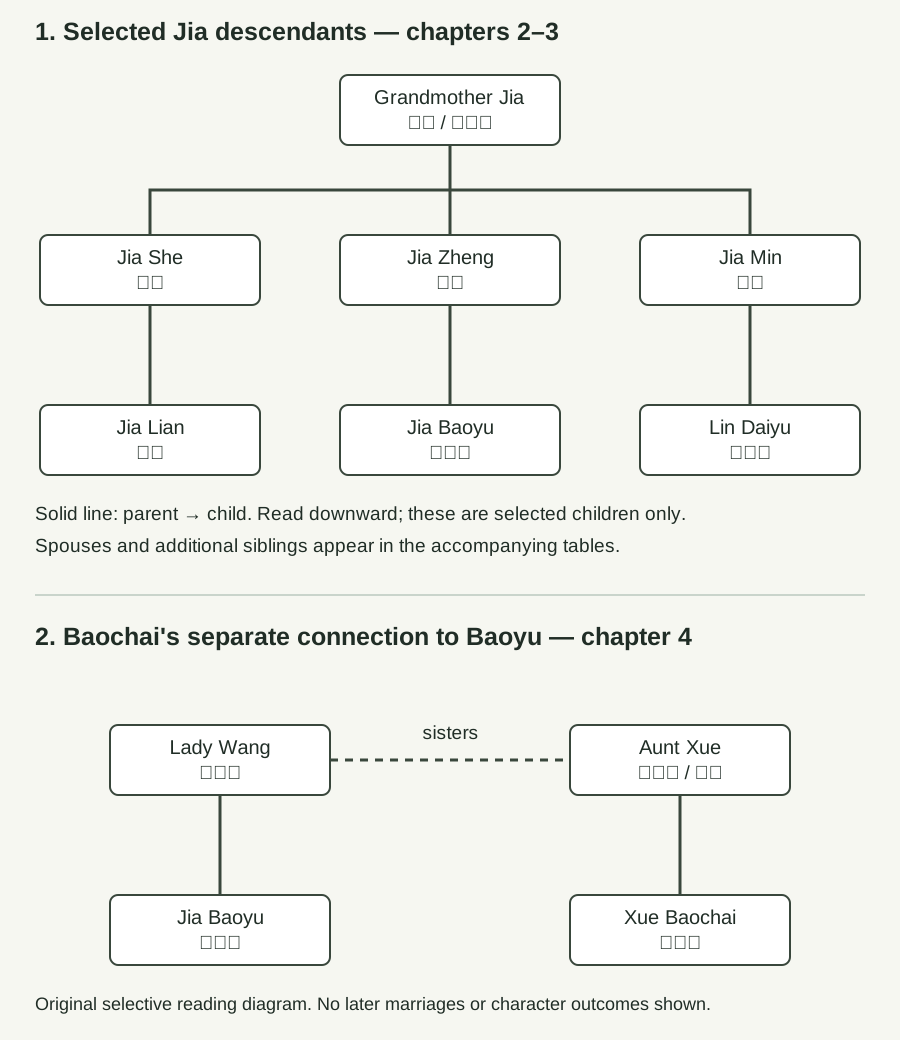
Download the original opening family tree (SVG). On a narrow screen, slide the diagram inside its frame. The tables and step-by-step routes below provide the same key information in text.
Daiyu and Baoyu: cousins through Jia Min and Jia Zheng
Trace Daiyu upward first: Lin Daiyu → her mother Jia Min → Grandmother Jia. Now trace Baoyu: Jia Baoyu → his father Jia Zheng → Grandmother Jia. Jia Min and Jia Zheng are siblings, so Daiyu and Baoyu are first cousins. Daiyu’s Jia connection comes through her mother; her surname Lin does not make her unrelated to the family.
Chapter 2 identifies Lin Ruhai’s daughter as Daiyu and later identifies his wife Jia Min as the younger sister of Jia She and Jia Zheng. Chapter 3 makes Daiyu’s maternal-grandmother and maternal-uncle connections explicit during the arrangements for her journey and arrival. [1] [2]
A short Chinese anchor is 「赦,政二公之胞妹」: our translation, “the younger sister of Jia She and Jia Zheng.” That phrase supplies the sibling link; it does not require a later romance summary to explain the family relationship.
For Daiyu, Grandmother Jia is her maternal grandmother. For Baoyu, the same woman is his paternal grandmother. Their different surnames and different routes to the same elder are exactly why one shared “grandmother” box is useful.
Baochai and Baoyu: a different first-cousin connection
Trace Xue Baochai → her mother Aunt Xue, then cross the sister link to Lady Wang → her son Jia Baoyu. Chapter 4 identifies Aunt Xue, born Wang, and Jia Zheng’s wife Lady Wang as sisters born of the same mother: 「是一母所生的姊妹」. Our translation is “sisters born of the same mother.” [3]
Baoyu and Baochai are therefore first cousins through their mothers. This is a different route from Baoyu’s relationship to Daiyu, which runs through his father and Daiyu’s mother. Do not put all three young people beneath one parental couple.
These two cousin links also do not make Daiyu and Baochai sisters or establish that they share a grandmother in this diagram. A relationship must be traced between the actual two people in question. Baochai’s residence with the Jia household does not change her mother into Lady Wang or her surname into Jia.
Add spouses and siblings without flattening the household
| Person or pair | Connection to keep | Chapter evidence |
|---|---|---|
| Jia Zheng and Lady Wang | Baoyu’s father and mother. Lady Wang’s sister is Aunt Xue. | 2 names Lady Wang and her children; 4 supplies the sister link. |
| Jia Min and Lin Ruhai | Daiyu’s mother and father; Jia Min is Jia She and Jia Zheng’s sister. | 2; 3 repeats the uncle and grandmother links. |
| Jia She → Jia Lian | Father and son; Jia Lian is Baoyu and Daiyu’s cousin through this Jia branch. | 2; Daiyu recalls the link in 3. |
| Jia Lian and Wang Xifeng | Married couple. Xifeng is also Lady Wang’s niece. | 2 describes both links; 3 names Xifeng and calls her Lian’s wife. |
| Jia Zhu / Jia Yuanchun | Older children of Jia Zheng and Lady Wang; siblings of Baoyu. | 2 describes the children and identifies Yuanchun later in the conversation. |
| Jia Yingchun / Jia Tanchun / Jia Xichun | Do not make all three daughters of Lady Wang because they are introduced together. | 2 distinguishes their branches; Yingchun’s parentage wording has variant readings noted on the source page. |
Wang Xifeng is especially easy to misplace. Her married connection is to Jia Lian, son of Jia She. Her natal connection is as Lady Wang’s niece. Chapter 3 introduces her as 「璉嫂子」, our rendering “Lian’s wife” in this scene, and then names Wang Xifeng. She is not Jia Zheng’s wife, Baoyu’s mother or a daughter of Grandmother Jia. [2]
For the three younger “Spring” sisters, keep the distinction visible. In the cited chapter 2 text, Tanchun is Jia Zheng’s daughter by a concubine, and Xichun is Jia Zhen’s sister. The source’s footnote gives differing readings for Yingchun’s parentage, including different mother descriptions and even a Jia Zheng reading. This selected tree therefore does not add a supposedly universal mother for her. Check your edition instead of silently merging variants. [1]
The chart also omits additional siblings and descendants to stay readable. An omitted child is not a claim that the parent had only one child. Use the table to add a name when it matters to the scene you have actually reached.
The Ningguo check: Jia Jing, Jia Zhen and Jia Rong
Keep this short chain beside the main chart: Jia Jing → his son Jia Zhen → his son Jia Rong. Chapter 2 supplies those links while describing the Ningguo branch; it also explains that the founding Ningguo and Rongguo dukes were brothers. The two households belong to connected branches of the Jia family, not two names for one parental couple. [1]
At the opening of chapter 5, You Shi is identified as Jia Zhen’s wife, and Lady Qin, or Qin Shi, as Jia Rong’s wife. Qin addresses Baoyu as 「寶叔」, our rendering “Uncle Bao.” [4] That is a generational kinship address within the extended family. It does not mean Jia Rong’s father and Baoyu are brothers.
Do not use a character’s apparent age as the family tree. First trace the named parent-child links, then consider the form of address. The chapter itself draws attention to how a kinship-generation rule can sit awkwardly beside youth. You can understand the address without opening a later plot explanation.
Four checks before you continue reading
These original reading checks use only the opening relationships explained above.
Case 1
A note calls Grandmother Jia the paternal grandmother of both Baoyu and Daiyu. Which half needs correction?
Show answer and explanation for case 1
Daiyu’s. Grandmother Jia is her maternal grandmother, through Jia Min.
Baoyu reaches Grandmother Jia through his father Jia Zheng; Daiyu reaches her through her mother Jia Min. The shared elder does not make the routes identical.
Case 2
Because Baochai and Daiyu are both Baoyu’s cousins, can you put them beneath the same mother in a simplified chart?
Show answer and explanation for case 2
No. Keep Daiyu under Jia Min and Baochai under Aunt Xue.
Daiyu’s connection runs through Jia Min and Jia Zheng. Baochai’s runs through the sisters Aunt Xue and Lady Wang. Two relationships to Baoyu do not create a sister relationship between the two cousins.
Case 3
Wang Xifeng is Lady Wang’s niece and an influential married woman in the household. Does that make her Jia Zheng’s wife?
Show answer and explanation for case 3
No. Xifeng is married to Jia Lian; Lady Wang is Jia Zheng’s wife.
The niece link and the marriage link are separate. Chapter 3 identifies Xifeng as Lian’s wife, while chapter 2 supplies Lian’s parentage and the Lady Wang connection.
Case 4
Qin Shi calls Baoyu “Uncle Bao.” Should you draw Baoyu as Jia Rong’s father’s own brother?
Show answer and explanation for case 4
No. Preserve the extended-family generation address without inventing a direct sibling link.
Chapter 2 gives Jia Jing → Jia Zhen → Jia Rong. Chapter 5 identifies Qin as Jia Rong’s wife and uses the uncle address. A form of address is not a substitute for the named genealogy.
Keep a small edition-matching record
Download the opening family check and edition record (TXT). Write the translator, volume and chapter you have reached, then match a name in this guide to the spelling in your edition. Keep your chapter or passage reference beside any relationship you add.
For chapter 2, concentrate on the family explanation in the conversation. In chapter 3, use Daiyu’s arrivals and greetings to connect a name to a person in a room. In chapter 4, add the Xue family through the sister link. In chapter 5, check the Ningguo generation and marriage links before following the dream sequence.
Leave a question blank if the chapter has not answered it. Avoid searching for a complete late-novel family tree just to fill every box: those charts may reveal later marriages, deaths or outcomes that this opening companion deliberately leaves out. Add relationships as your reading supplies them.
Sources and further reading
- Dream of the Red Chamber, chapter 2: Wikisource Chinese reading textLin Ruhai/Daiyu introduction and Leng Zixing’s family conversation: Jia siblings, parents, spouses and Ningguo chain. The source footnote documents variant Yingchun parentage readings; the diagram does not collapse them into one mother.
- Dream of the Red Chamber, chapter 3: Wikisource Chinese reading textDaiyu’s journey and household introductions: maternal grandmother/uncles, Jia Lian and Wang Xifeng, and forms of address. Selected passages read; no later-novel kinship imported.
- Dream of the Red Chamber, chapter 4: Wikisource Chinese reading textAunt Xue and Lady Wang explicitly described as sisters; Xue Pan and Xue Baochai’s mother and their arrival. Chapter’s separate criminal-case narrative not used as genealogy evidence.
- Dream of the Red Chamber, chapter 5: Wikisource Chinese reading textOpening Ningguo gathering names You Shi as Jia Zhen’s wife and Qin Shi as Jia Rong’s wife and uses “Uncle Bao.” Prophetic poems, later outcomes and dream interpretation are outside this guide.