Wang Xifeng in Dream of the Red Chamber: Character Guide
Revised · Chapter-limited literary guide
Understand Xifeng by keeping her relationships beside what she says, arranges and controls in a scene. Her quick social responses and organizational ability matter, but so do the limits of her delegated authority and the people affected by it.
Reading scope: Early examples in chapters 2, 3 and 6; a separately marked detailed section discusses the funeral and management in chapters 13–14. No later whole-novel outcomes.
Who Wang Xifeng is
Wang Xifeng is Jia Lian’s wife. Jia Lian is Jia She’s son, and Xifeng is Lady Wang’s niece. These connections place her within the Rongguo household while keeping her Wang-family relationship relevant. She is not Lady Wang under another name, Jia Zheng’s wife or Baoyu’s mother. [1, 2]
Chapter 2 introduces information about her through a speaker’s account of the family. Chapter 3 then gives an encounter in which the reader can observe her arrival, speech and practical responses. Keep the reported description separate from the observed action. This makes it possible to test an early reputation against a scene rather than treating it as a permanent verdict.
Spoiler scope: the first sections discuss chapters 2, 3 and 6. The section headed “Later scenes: chapters 13–14” explains a funeral-management episode and its coercive practices. Stop before that heading if you have not reached those chapters. This guide does not reveal later marriages, deaths or Xifeng’s eventual fate.
The relationships you need for these scenes
Use a small relationship record instead of a complete later-life biography. The early encounters become clearer when each connection retains its own category.
On a narrow screen, scroll the table sideways to read all columns.
| Person or setting | Connection relevant here | Evidence to locate |
|---|---|---|
| Jia Lian | Xifeng’s husband; Jia She’s son | Family account in chapter 2 and identification in chapter 3 |
| Lady Wang | Xifeng’s aunt; a person who asks her about household arrangements | Chapter 3 introduction and practical exchange |
| Grandmother Jia | The elder whose gathering and wishes shape the reception | Chapter 3 entrance, teasing address and response |
| Lin Daiyu | Newly arrived relative whom Xifeng greets and assists | Chapter 3 questions, welcome and luggage arrangements |
| Ping’er | Attendant participating in access and practical action | Chapter 6 visit and delivery of assistance |
| Liu Laolao | Visitor seeking help through a qualified Wang-family connection | Chapter 6 account, intermediaries and gift |
A form of address such as the greeting Daiyu uses should remain beside the family information that identifies Xifeng. An address can express a relationship within the gathering without supplying an entirely new parentage. If the names themselves are confusing, use the early name-and-address card.
Chapter 3: the entrance is seen through Daiyu’s situation
Xifeng’s laughter is heard before her arrival is described. Daiyu has noticed the quiet, restrained conduct of the surrounding people and wonders who can enter so freely. The contrast belongs to the scene and to Daiyu’s perception as a newcomer. It gives the entrance force before the family identification is complete. [2]
The elaborate description of clothing and appearance adds to that force. Grandmother Jia’s teasing address then helps explain the familiar place Xifeng occupies in this gathering. Read these details together: sound, the newcomer’s reaction, appearance, the elder’s response and the supplied relationship.
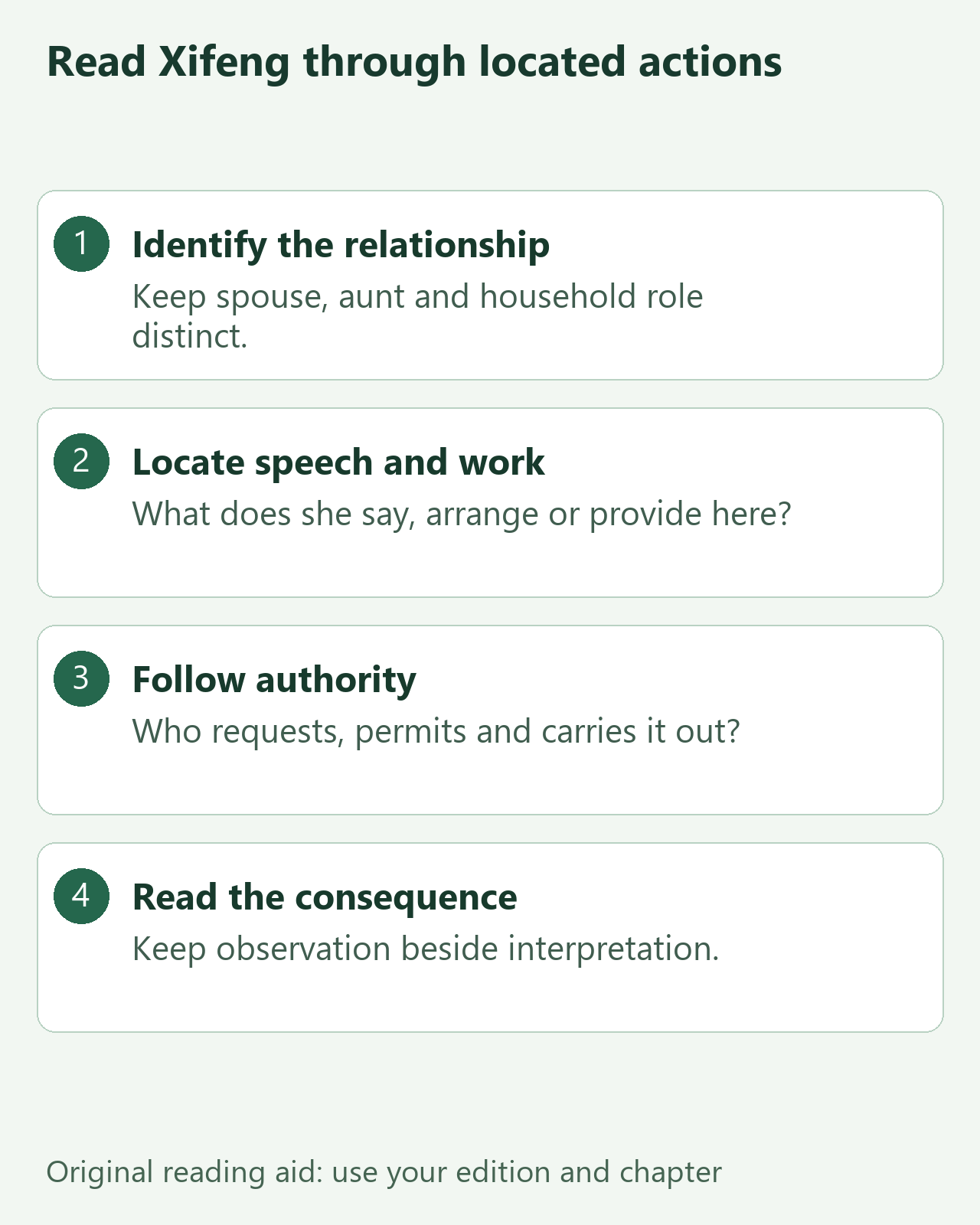
You do not need a historical portrait to establish what the passage says. The original reference diagram below records a way to read the scene; it is not presented as Xifeng’s likeness. For a quotation about her appearance, return to the wording and location in your own edition.
A supported interpretation can say that Xifeng’s entrance contrasts with the restraint Daiyu first observes and makes her social confidence visible. It should not convert Daiyu’s initial surprise into an objective judgment about every act Xifeng performs throughout the novel.
Speech and practical action work together in the reception
Xifeng praises Daiyu, mentions the loss of Daiyu’s mother and wipes tears. When Grandmother Jia asks her not to reopen the sorrow, Xifeng quickly changes her response. This is a visible adjustment to the elder and to the occasion. The passage does not give a complete private explanation that lets us declare with certainty whether every tear is insincere. [2]
Her praise also addresses the family relationship and Grandmother Jia’s affection. A flattering comparison with a granddaughter should not be used to rewrite Daiyu’s actual parentage. Read the compliment as speech in a reception, with both the newcomer and the elder present.
Then Xifeng asks about age, education, medicine, preferences and possible difficulties with attendants. She asks whether Daiyu’s luggage has arrived and orders rooms prepared for the accompanying people. Those practical actions keep the scene from being only a performance of welcome.
Lady Wang’s questions about the allowance and cloth add a second kind of evidence. Xifeng reports on arrangements and says she has anticipated the need for cloth. A useful character analysis connects the speed of her social response with these concrete tasks. “She is powerful” is less precise than “she can respond to the elder and organize the newcomer’s immediate needs.”
Chapter 6: assistance is shaped by access and unequal resources
Liu Laolao’s visit lets the reader see Xifeng from another position. The visitor needs help and approaches through intermediaries; she does not begin with the same access as a close household member. Zhou Rui’s wife carries Lady Wang’s response, which qualifies the Wang-family connection and leaves Xifeng to consider the request. [3]
Xifeng hears the need, arranges food and provides twenty taels, with additional cash for transport. She frames the assistance alongside a statement that a large household has difficulties of its own. Liu Laolao’s response measures those difficulties against her much narrower circumstances. Keep both perspectives visible.
The scene supports an analysis of assistance, access and unequal resources. It does not supply a complete balance sheet or a reliable modern currency conversion. Nor does one act of generosity settle every ethical question about the character. Locate the gift and response before making a wider comparison.
Ping’er’s participation matters to what actually happens: practical control is carried through people and objects, not only an abstract title. The household-rank guide explains how service, delegated responsibility and kinship can operate together without becoming one ladder.
Later scenes: chapters 13–14 show delegated authority
Detailed spoilers for chapters 13–14 begin here. The discussion concerns the funeral following Qin Keqing’s death and the management work assigned to Xifeng. It stops within these selected scenes and does not explain later outcomes. [4, 5]
In chapter 13, Jia Zhen seeks help with the inner arrangements while You Shi is unwell. Baoyu recommends Xifeng. The request involves the older women, and Lady Wang expresses concern about the task. Xifeng is eager to display her ability, but she also distinguishes the inner work assigned to her from external matters Jia Zhen handles.
Jia Zhen supplies the Ningguo authority token, duipai, and tells her to prioritize the arrangements rather than saving money. Lady Wang agrees while directing her to consult Jia Zhen or You Shi if difficulties arise. This is a specific delegation. It does not make Xifeng the hereditary head of Ningguo or remove every limit on her role.
The token matters because authority has a material route. A person can authorize an expense or movement of supplies through an object and recorded instruction. Read the token beside the task, not as an unexplained symbol of limitless personal power.
Organizational ability is shown through assignments and records
Xifeng identifies five problems in the arrangements: mixed groups and lost goods, unassigned duties and avoidance of responsibility, excessive expense or false claims, uneven work, and favoritism that leaves some people uncontrolled while blocking others. The list is attached to the task before her. [4]
Chapter 14 follows with named responsibilities for reception, food, ritual arrangements, utensils, gifts, lighting and other work. Timing, custody and accountability are made explicit. These details provide evidence for organizational ability more effectively than repeating a general adjective such as “capable.” [5]
Later in the selected management passage, requisitions and records connect Ningguo and Rongguo business. Xifeng distinguishes claims, requires the relevant documentation and controls the issuing of an authority token. The scene places requests, written records and material action together.
This is literary analysis of a fictional episode. The arrangements are not a tested modern management system, and the chapter’s timing should not be converted into a contemporary work schedule without separate justification. The point is to observe how the narrative makes responsibility and control visible.
Capability does not erase the coercion in the scene
The same chapter includes a servant’s punishment for lateness: twenty blows and the loss of a month’s silver and rice allowance. Further punishments are threatened for later offenses. Keep the punishment actually narrated separate from the future threats. Both help explain the atmosphere of fear. [5]
A reading that admires the organization should still account for who bears its costs. Named responsibilities and records may make work more orderly while punishment and threats enforce compliance. Treating efficiency as proof of moral goodness would omit an important part of the passage.
The narration also presents Xifeng’s satisfaction in exercising authority. Compare that presentation with the earlier reception and assistance scenes, where responsiveness and practical action are also visible. The comparison can show a complex pattern without making a medical diagnosis or pretending to know every private motive.
A careful conclusion might be: “The episode shows Xifeng’s capacity to organize delegated work, while the narrated punishment makes its coercive force visible.” Both parts have located evidence. Neither needs a prediction about the entire family’s future.
Build a character argument from a relationship and an action
Choose one scene and state the relationship relevant to it. Then name something Xifeng says or does and the response or consequence the chapter supplies. Finally, identify what your interpretation adds beyond those observations.
For chapter 3, you might connect Lady Wang’s request with Xifeng’s handling of cloth and the newcomer’s arrangements. For chapter 6, connect the qualified family affiliation, intermediaries, gift and visitor’s response. For chapters 13–14, connect delegation and records with the punishment used to enforce the arrangements.
Do not move automatically from one scene to a permanent label. A comparison is stronger when it preserves differences in task, audience, access and consequences. Your edition’s chapter and page references let another reader check whether the connection is persuasive.
The blank character scene card below helps retain those anchors. For another literary comparison, the poetry-and-characterization guide has its own later-chapter spoiler scope. Choose it only when you have reached the passages it discusses.
Worked reading examples
Each example shows how to check a reading claim against the stated chapter or passage.
A compliment becomes a false family fact
A reader treats Xifeng’s praise of Daiyu as proof that Daiyu is Grandmother Jia’s biological granddaughter through a son. Keep the actual family connection and read the praise as speech in the reception. Xifeng addresses the newcomer’s appearance and the elder’s affection. The compliment can reveal social skill without replacing the genealogy supplied by the novel.
Quickly changing tears are treated as certain private deception
Your analysis says the chapter proves that Xifeng feels no sorrow. The observed evidence is narrower: she wipes tears and changes her response when Grandmother Jia objects. Describe the adjustment and explain your interpretation of its social effect. A claim about all private feeling would require more than the change in outward response alone.
A token is mistaken for unrestricted hereditary power
After chapter 13, you write that Xifeng has become head of the Ningguo family. Revisit the request, the older women’s involvement, the task division and the token. She receives authority for particular funeral arrangements while other responsibilities and consultation remain in view. “Delegated management” fits the scene more closely than a new hereditary position.
An efficient arrangement is praised without its human cost
A paragraph lists duties and records from chapter 14 but leaves out the servant’s punishment. Add the narrated blows and allowance deduction without graphic elaboration, then distinguish later threats from that event. The revised argument can recognize organizational ability while explaining how fear and coercion support the order the scene describes.
Wang Xifeng character scene card
Use this optional text record to keep an edition, passage, observation and interpretation together. Leave unconfirmed information open. Downloading the blank record does not send your completed notes to this site.
Frequently asked questions
Is Wang Xifeng the same person as Lady Wang?
No. Xifeng is Jia Lian’s wife and Lady Wang’s niece. Chapter 3 identifies her and shows a practical exchange between the two women. A shared surname does not merge their identities or roles.
Which chapters introduce the evidence discussed here?
Chapter 2 supplies a reported family account; chapter 3 shows Xifeng’s entrance and household responses; chapter 6 shows a visitor seeking assistance. The separately warned section discusses delegated funeral management in chapters 13–14.
Does the funeral episode simply prove that she is a good manager?
It shows organizational ability through duties, records and control of resources, but it also narrates punishment and threats. A fuller analysis accounts for both the arrangements and their coercive cost instead of treating efficiency as a complete moral verdict.
Does this page disclose Xifeng’s eventual fate?
No. It stops within the stated early and chapter 13–14 examples. It does not use later outcomes to explain motives or determine the character’s meaning in advance of your reading.
Choose the next reading task
Sources and what they support
- Dream of the Red Chamber, chapter 2
Chapter coverage: the reported family account, branch and relationship information, and stated positions. A speaker’s report remains distinguishable from an observed action.
- Dream of the Red Chamber, chapter 3
Chapter coverage: Daiyu’s arrival, relationships, forms of address, Xifeng’s entrance and practical household exchange.
- Dream of the Red Chamber, chapter 6
Chapter coverage: surname affiliation, intermediaries, visitor access and the assistance provided. These details do not supply a complete household balance sheet.
- Dream of the Red Chamber, chapter 13
Selected passages about the management request, older women’s involvement, authority token, task division and five identified problems. No whole-chapter or whole-novel review claimed.
- Dream of the Red Chamber, chapter 14
Selected passages about assignments, records, the narrated punishment, further threats and requisitions. Literary evidence, not a tested modern management method.
This guide offers a chapter-limited literary reading. Check exact quotations and variant wording in your chosen edition.