Practice worksheet
Rongguo vs Ningguo: The Two Jia Households Explained
Rongguo and Ningguo belong to connected Jia branches founded by brothers. Baoyu’s selected line is Rongguo; Jia Jing, Jia Zhen and Jia Rong belong to Ningguo. Follow the named host and location in each scene, while keeping family descent, shared residence and generation addresses separate. This original chart, name comparison and reading card cover introductions in chapters 2–5, with that spoiler boundary visible.
Opening-chapter boundary: family introductions and visits
This guide explains the two Jia branches and the scene locations introduced in chapters 2–5 of Dream of the Red Chamber, also called The Story of the Stone. It reveals Daiyu’s arrival and the opening Ningguo garden visit. If you have not reached them, save the corresponding sections for later.
It leaves out later marriages, deaths, household outcomes and explanations of chapter 5’s prophetic poems. The branch chart is selective. An omitted person is not a claim that the family had no other children.
Our explanations and diagram are original. Chinese passage anchors come from the linked Wikisource reading text, with the opening chapter 5 visit checked against H. Bencraft Joly’s older translation. They are reading aids, rather than a claim that every manuscript or translation has identical wording. Match names to your own edition before adding them to a notebook.
Rongguo and Ningguo are related branches, not interchangeable names
Chapter 2’s family explanation says the founding Ningguo and Rongguo dukes were brothers born of the same mother, with the Ningguo duke the elder. The two households therefore belong to connected Jia branches. “Ningguo” and “Rongguo” are not two names for Baoyu’s parents or two spellings of the same mansion. [1]
| Reading question | Ningguo | Rongguo |
|---|---|---|
| Chinese household label | 寧國府 / 宁国府 | 榮國府 / 荣国府 |
| Founding relation in chapter 2 | The elder of the two founding brothers. | The younger founding brother’s branch. |
| Selected descent line | Jia Daihua → Jia Jing → Jia Zhen → Jia Rong. | Jia Daishan → Jia Zheng → Jia Baoyu; Jia She and Jia Min belong to this branch too. |
| Opening people to recognise | Jia Zhen, his wife You Shi; Jia Rong, his wife Qin Shi. | Grandmother Jia, Jia She, Jia Zheng, Lady Wang and Baoyu; Daiyu arrives through her maternal connection. |
| Scene checkpoint | Daiyu passes its named gate in chapter 3; the garden visit occurs here at the opening of chapter 5. | Daiyu proceeds here in chapter 3 to meet her maternal grandmother. |
The elder founding branch does not mean every Ningguo person is older than every Rongguo person. Nor does belonging to one branch tell you where someone is standing in a particular scene. The novel moves visitors, relatives and attendants between spaces.
In this guide, branch describes family descent; household or mansion can describe the social group or its residence, depending on the passage. 府 is part of the household label. Do not read the two names as unrelated countries or use a place label as a person’s name.
Trace the two selected lines before reading an address
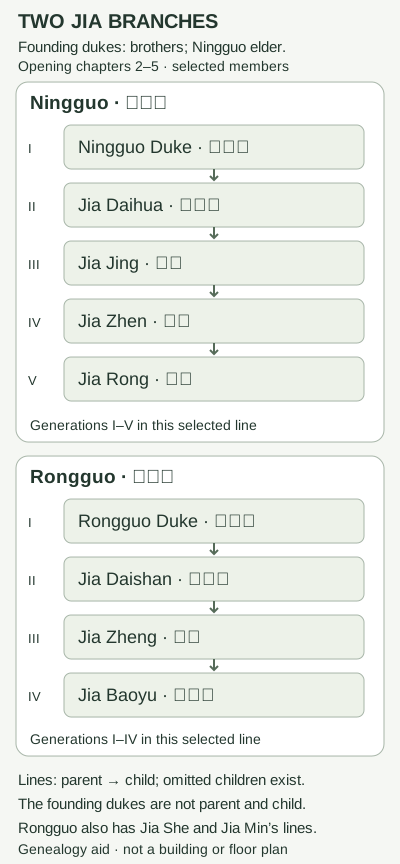
Download the original two-branch diagram (SVG). Its Ningguo line runs through five illustrated generations, while the selected Rongguo line ends with Baoyu in the fourth. The difference in where the lines stop does not mean one branch has no other descendants.
Chapter 2 supplies Jia Daihua’s sons and the Jia Jing–Jia Zhen–Jia Rong line. It describes Jia Daishan’s sons Jia She and Jia Zheng and identifies Jia Min as their sister. [1] The diagram follows only Jia Zheng’s line on the Rongguo side to keep the comparison readable.
Grandmother Jia belongs in your Rongguo reading notes as Jia Daishan’s surviving wife and the mother of Jia She, Jia Zheng and Jia Min. She is not Jia Jing’s mother. For Baoyu’s cousin connections through Jia Min and through Lady Wang, use the separate opening family tree; this chart solves the two-branch and generation problem.
Chapter 3: follow Daiyu past Ningguo to Rongguo
On arriving in the capital, Daiyu sees a gate labelled Ningguo and recognises the elder branch. The narration then takes her westward a short distance to the similarly imposing Rongguo entrance, where she enters through a side gate and is taken to her maternal grandmother. [2]
The sequence gives a useful local orientation: Ningguo is to the east of the Rongguo entrance she reaches. It does not provide a measured street plan, room dimensions or a complete map of all later gardens.
Keep the chapter viewpoints distinct. In chapter 2, Jia Yucun describes having seen the family’s old houses in Jinling; chapter 3 narrates Daiyu’s arrival in the capital. Do not combine the two into one literal city walk just because both use the mansion names. [1] [2]
Daiyu’s surname Lin does not make her an unrelated visitor. Her mother Jia Min belongs to the Rongguo branch, and Grandmother Jia is her maternal grandmother. Record family connection and arrival location beside each other instead of using the surname alone to classify the scene.
A different gate or room does not automatically mean Ningguo
Later in Daiyu’s chapter 3 introductions, Lady Xing takes her to Jia She’s quarters by another entrance. The narration describes movement past the Rongguo main gate and into a black-painted gate, and Daiyu considers the courtyard to be divided from the Rongguo garden area. The named host is Jia She, who belongs to the Rongguo branch. [2]
If you lose your place among gates and courtyards, first write the host’s name, then the relationship, then the movement the narration actually describes. Going eastward or entering a new gate is not, by itself, evidence that the scene has moved to Ningguo.
The two-branch diagram cannot settle every architectural detail. A useful note can simply say “Lady Xing takes Daiyu to Jia She’s quarters; Jia She is her Rongguo-side uncle.” Keep exact route questions beside the passage rather than inventing a full floor plan.
Shared residence does not rewrite family relationships
Xichun is a useful test. Chapter 2 identifies her as Jia Zhen’s sister in the Ningguo branch, while explaining that the girls study together under Grandmother Jia’s care. [1] Seeing Xichun with the Rongguo girls does not make Lady Wang her mother or Jia Zheng her father.
Keep three notebook fields distinct: a person’s established family branch, their residence or visit in the current scene, and the person addressing or caring for them. Those fields may point to different parts of the extended family without contradicting each other.
Wang Xifeng gives another check: she is Jia Lian’s wife, and Jia Lian is Jia She’s son. Her practical importance in rooms associated with Jia Zheng’s household does not make her Jia Zheng’s wife. Chapter 2 describes Lian living with his uncle Jia Zheng and helping with household matters; chapter 3 identifies Xifeng during Daiyu’s introductions. [1] [2]
The guide does not assign every servant, relative or visitor one permanent room. Add a location when the scene supplies it. Leave an unknown blank instead of treating a crowded group introduction as a complete genealogy.
Chapter 5 opening: identify the host, visitor and uncle-generation address
The opening garden gathering takes place at Ningguo. You Shi, Jia Zhen’s wife, prepares the entertainment, and Grandmother Jia’s group comes over. Qin Shi, identified as Jia Rong’s wife, helps arrange Baoyu’s rest. These named roles and the Ningguo location appear in the Chinese reading text and in Joly’s older translation. [3] [4]
For this scene, write “You Shi: host; Baoyu: visitor from the Rongguo line; Qin Shi: Jia Rong’s wife.” The place where Baoyu rests does not change his parents or transfer him to the Ningguo branch.
Qin uses the address 「寶叔」, our rendering “Uncle Bao.” In the illustrated genealogy Baoyu and Jia Zhen are in the fourth generation, while Jia Rong is in the fifth. Baoyu therefore belongs to the uncle generation relative to Rong, despite being young. The address does not establish that Baoyu and Jia Zhen are brothers.
The linked Chinese chapter 5 has a transcription-quality notice. This guide uses only the opening visit details checked against the older English text, rather than treating every word on that web page as settled. Joly has different spellings, and some wording differs between the two texts. Use your edition for the precise sentence you are reading. The dream’s later poems and their outcomes are outside this guide.
Match the complete name in your edition
Project Gutenberg’s catalogue identifies H. Bencraft Joly as the translator of its Hung Lou Meng, Book I. [5] In the inspected chapter 5 opening, that translation uses “Ning mansion,” “Jung mansion,” “Chia Chen” and “Chia Jung.” [4] These are edition-matching clues, not preferred spellings for every translation.
| This guide | Chinese match | Joly chapter 5 clue |
|---|---|---|
| Ningguo household | 寧國府 / 宁国府 | Ning mansion — a household or place. |
| Rongguo household | 榮國府 / 荣国府 | Jung mansion — a household or place. |
| Jia Zhen | 賈珍 / 贾珍 | Chia Chen — You Shi’s husband. |
| Jia Rong | 賈蓉 / 贾蓉 | Chia Jung — Qin Shi’s husband, a person. |
| Qin Shi | 秦氏 | Mrs. Ch’in — Jia Rong’s wife in this scene. |
If “Jung” catches your eye, ask whether the sentence names a mansion or a person. “Chia Jung’s wife” refers to Jia Rong’s spouse; it does not make Qin the wife of a building or establish that she belongs to the Rongguo branch. Whole labels and the speaker’s relationships matter more than a shared syllable.
Write the translator and chapter beside your name list. Copy the spelling used in that edition, then add the Chinese or pinyin match if useful. Do not silently change an edition’s names halfway through your notes.
Download a small household-and-scene reading card
Download the editable Jia household scene card (TXT). It includes the selected branch lines, the place/person name distinction, host and visitor fields, a passage reference and the opening chapter checkpoints.
- Check the chapter boundary before consulting an explanation.
- Name the household or location given in the passage.
- Identify host and visitor before drawing a new relationship.
- Trace the known parent links when a generation address is confusing.
- Keep residence, family branch and form of address in separate fields.
A short note can be enough: “Chapter 5 opening, Ningguo garden; You Shi hosts; Baoyu visits; Qin Shi is Jia Rong’s wife.” It tells you where the scene is and who is acting without requiring a later plot summary.
For a broader start, return to the beginner’s reading guide. For the cousin links between Baoyu, Daiyu and Baochai, use the opening family tree. Add further branches as your actual reading introduces them.
Six checks for placing a household scene
These original reading checks use only the opening relationships, scene locations and edition clues explained above.
Case 1
Daiyu passes a Ningguo-labelled gate and then continues west to meet her grandmother. Is her arrival destination Ningguo?
Show answer and explanation for case 1
No. The chapter 3 sequence takes her onward to Rongguo.
The first named gate is not the final destination. Retain the movement and the family link: Grandmother Jia is Daiyu’s maternal grandmother on the Rongguo side.
Case 2
Xichun studies with the girls under Grandmother Jia’s care. Does that make her Jia Zheng and Lady Wang’s daughter?
Show answer and explanation for case 2
No. Chapter 2 identifies her as Jia Zhen’s sister in the Ningguo branch.
Shared residence and care do not replace the stated parent and sibling relationships. Record branch and current setting separately.
Case 3
A chapter 3 visit uses another gate to reach Jia She’s quarters. Must the new gate mean the scene is now Ningguo?
Show answer and explanation for case 3
No. Jia She belongs to the Rongguo branch; check the named host and actual route.
Movement to a different courtyard is not a new genealogy. The narration’s host and relationship supply a firmer reading clue than an assumed complete floor plan.
Case 4
Qin Shi calls Baoyu “Uncle Bao.” Should the chart add Baoyu as Jia Zhen’s brother?
Show answer and explanation for case 4
No. Preserve the uncle-generation address without inventing a direct sibling link.
The selected lines put Baoyu and Jia Zhen in the fourth generation and Jia Rong in the fifth. Generation within the extended family is different from sharing parents.
Case 5
In Joly, “Chia Jung’s wife” appears during the Ning mansion visit. Is Jung necessarily the Rongguo mansion?
Show answer and explanation for case 5
No. Chia Jung here is the person Jia Rong; his wife is Qin Shi.
Jung also occurs in “Jung mansion,” the Rongguo place label. Match the whole name and the sentence’s relationship rather than one syllable.
Case 6
You have read only chapter 1. Is this opening-chapters guide free of all later introductions?
Show answer and explanation for case 6
No. It discloses relationships and visits introduced in chapters 2–5.
Save the relevant sections until you reach them if you want to avoid those disclosures. A chapter-limited guide can still reveal events beyond your current chapter.
Sources and further reading
- Wikisource Chinese reading text: Chapter 2Founding brothers, selected branch lines, Grandmother Jia, Jia Min, Jia Lian and Xichun’s family/residence distinction; a reading text with variant notes, not a universal critical edition.
- Wikisource Chinese reading text: Chapter 3Daiyu’s capital arrival past Ningguo to Rongguo, her grandmother and uncle connections, and the Jia She courtyard visit.
- Wikisource Chinese reading text: Chapter 5 openingNingguo garden host, Qin Shi’s marriage connection and 宝叔 address, checked against Joly because this web transcription carries a quality notice.
- Project Gutenberg: Joly’s Hung Lou Meng, Book IInspected chapter V opening corroborates the Ningguo visit’s named location, You Shi as host, Qin as Jia Rong’s wife and the uncle-generation address; supplies the observed Ning/Jung and Chia Chen/Chia Jung spellings.
- Project Gutenberg catalogue: Hung Lou Meng, Book ITranslator identity and the edition record; the catalogue’s automatically generated plot summary is not used as literary evidence.