Chapter 7 at a glance
Wukong survives the ordered execution, then escapes Laozi’s Eight Trigrams furnace after forty-nine days. His renewed attack reaches the approaches to the heavenly palace, where Wang Lingguan and thirty-six thunder generals contain the fight without subduing him. The Jade Emperor calls Buddha, who tests Wukong’s claimed freedom with the palm wager and presses him beneath Five Elements Mountain.
The mountain is not the final action. Heaven celebrates the restored order; a report that Wukong’s head is protruding prompts Buddha to send a written seal, and guardians are appointed to maintain custody. The chapter promises eventual rescue but leaves its date unanswered. It does not yet narrate Wukong becoming a pilgrim.
The chapter title joins the escaped “Great Sage” in the furnace with the “mind-monkey” fixed beneath the mountain. The second phrase supplies a literary frame for containment. It should not erase the concrete sequence of failed executions, bodily consequences, wager and continuing supervision.
↑ On this pageFailed execution, furnace refuge and altered eyes
Weapons, fire and thunder fail to injure the bound Wukong. Laozi explains this resistance by what Wukong previously consumed: peaches, wine and the elixirs from five vessels have been forged into a resistant body. That is Laozi’s fictional explanation, given before furnace entry. The furnace is not the first moment at which Wukong resists injury.
Laozi proposes using the furnace to recover his elixir and reduce Wukong to ash. The restraining ropes and the implement through his shoulder bones are removed before he is pushed inside. At the same time, Erlang is rewarded and told to share the reward with his sworn brothers; his capture task has ended, while Heaven’s disposal of the prisoner remains unsolved.
Inside the furnace, Wukong takes refuge in the Xun position. The narration associates Xun with wind and says there is no flame there. Wind nevertheless brings smoke, which reddens and troubles his eyes. The name “fiery eyes and golden pupils” follows this bodily consequence. Treat it as this passage’s account of the altered eyes, not as an uncomplicated gift awarded for enduring fire.
After seven sevens—forty-nine days—Laozi opens the furnace to recover the elixir. Wukong, rubbing his eyes and shedding tears, hears the opening, sees light, jumps out and overturns the furnace. He knocks down those trying to stop him and flings Laozi aside. Survival has not made him obedient: his rebellion resumes.
For the precise relation between resistance, wind, smoke and the opening, use the furnace and fiery-eyes explanation.
↑ On this pageThe renewed attack and the appeal to Buddha
Wukong recovers his staff and drives through Heaven’s defences to the Hall of Penetrating Brightness, outside the Hall of Divine Mists. Wang Lingguan blocks him with a whip. The narration leaves their contest undecided; thirty-six thunder generals then surround Wukong. He responds with three heads and six arms and multiplies the staff into three, keeping them from closing on him.
This matters to the scene’s scale. The guards have not all vanished, and Buddha does not arrive immediately at the furnace. There is an intervening defence and an urgent appeal by the Jade Emperor. The envoys recount both the capture and the unsuccessful attempts to punish the prisoner before requesting help.
Buddha arrives with Ananda and Kasyapa, orders the thunder generals to stop fighting and calls Wukong forward. Wukong argues that strength should entitle him to Heaven’s throne. Buddha invokes the Jade Emperor’s long cultivation; Wukong replies that no ruler should hold the position forever. These are opposed claims made in dialogue, not a narrator’s historical account of political succession.
Wukong cites his transformations, longevity and cloud-somersault as qualifications. Buddha turns that boasting into a test: leave his right palm in one somersault. If Wukong succeeds, the throne will be yielded under the terms Buddha states; if he fails, Buddha tells him to return below and cultivate further. Wukong accepts because he thinks his travel ability makes a small hand an easy boundary to cross.
↑ On this pageThe wager, the returned evidence and the mountain
Wukong travels until he sees five flesh-red pillars and decides they mark the road’s end. He writes a claim of having visited on the middle pillar and leaves another bodily trace at the base of the first. He returns expecting the throne. The crucial error is the inference about where he has arrived: a distant-looking place does not by itself prove he crossed the palm’s boundary.
Buddha directs him to look down. The writing is on Buddha’s right middle finger, and the other trace is near the thumb. Wukong’s own marks connect the supposed distant endpoint to the hand he was required to leave. The scene defeats his proof of escape, rather than merely announcing that Buddha can move faster.
Wukong does not calmly accept the result. He attempts another leap. Buddha turns the palm, pushes him out of the western heavenly gate and changes the five fingers into linked mountains associated with metal, wood, water, fire and earth, named Five Elements Mountain. Keep the revealed marks and failed renewed attempt before the mountain action.
One useful reading is that Wukong can change appearances and travel enormous perceived distances without understanding the governing boundary. That is an interpretation anchored in the wager’s wording and returned evidence. It is not a measurement of geography or a universal claim about all Buddhist cosmology.
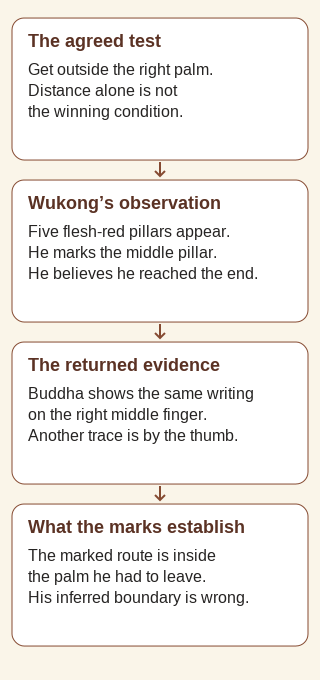
Read the palm wager and five-pillar evidence if you want to check each part of Wukong’s attempted proof.
↑ On this pageHeaven’s feast and the unfinished custody
Swipe the table on a phone, or focus it and use the arrow keys.
| Stage | Narrated development | Boundary to preserve |
|---|---|---|
| Execution | Blades, fire and thunder cannot injure Wukong. | Resistance is observed before the furnace. |
| Furnace | Xun refuge avoids flame; smoke affects his eyes. | Bodily harm and survival occur together. |
| Opening | After forty-nine days he jumps out and overturns the furnace. | The duration belongs to furnace firing. |
| Defence | Wang Lingguan and thirty-six thunder generals confront him. | Buddha follows an appeal during this renewed crisis. |
| Wager | Wukong’s marks reappear on the right hand. | His inferred endpoint does not prove escape. |
| Mountain | A renewed leap is prevented; five fingers become linked mountains. | Wukong is restrained, not narrated as released. |
| Celebration | Heaven holds the Peace-in-Heaven feast with thanks and offerings. | Public relief precedes a new custody report. |
| Seal | After the report about his head, Ananda attaches Buddha’s slip. | The written restraint is a later response. |
| Supervision | A local earth deity and Five-Direction guardians watch him. | Future rescue is promised without its exact date. |
After the mountain action, the Jade Emperor thanks Buddha and asks him to remain for a feast. The invited divinities bring offerings; Buddha names the gathering the Peace-in-Heaven assembly. The Queen Mother presents peaches, while the Longevity Star and Barefoot Immortal also give thanks. This extended celebration matters because the narrator has not yet finished the practical business of custody.
A patrolling official reports that Wukong has put his head out. Buddha supplies a slip bearing six golden syllables and gives it to Ananda, who attaches it to a square stone on the summit. The mountain takes root and closes its seams. The passage still allows Wukong breath, his hands and some struggling: the seal is restraint, not erasure.
Buddha then summons an earth deity and the Five-Direction guardians to reside there and supervise him. The specified iron balls and molten copper are fictional punitive provisions, not advice about consumption. Buddha promises someone will rescue Wukong when his punishment is complete. The final question leaves the year and month unresolved; later verses do not provide a narrated release inside this chapter.
The ending therefore combines settled authority with an unsettled life. Heaven celebrates, but custody needs an additional measure and ongoing watchers. That contrast gives the pause narrative purpose without pretending Wukong has already accepted a teacher or joined the scripture journey.
Use the mountain, seal and guards guide for the successive layers of restraint.
↑ On this pageThree chapter 7 corrections
These are original reading exercises, not quotations or reader case reports. Try the correction before opening the answer.
What lasts forty-nine days?
A note says Wukong spends forty-nine days under the mountain before the seal is applied. Identify the actual interval.
Show answer
The forty-nine-day interval is the furnace firing before Laozi opens it.
The mountain and its seal follow the escape, renewed battle and wager; this passage supplies no equivalent mountain interval.
What proves Wukong is still inside the palm?
A note says five pillars prove he reached the edge of the universe. Supply the returned evidence.
Show answer
The inscription appears on Buddha’s right middle finger, with the second trace near the thumb.
Wukong takes the pillars for the road’s end; the marks overturn his interpretation of the boundary.
Has the chapter finished when the mountain appears?
A summary stops at the five mountains. Name the later developments it misses.
Show answer
Heaven’s feast, the head-out report, Ananda attaching the seal and the appointment of watchers.
The final promise of rescue keeps the future open, while the chapter leaves the date unknown. None of these details is an already narrated release.
Sources and text boundaries
Spoilers are limited to the chapters named here. This is an English reading companion to the cited Chinese digital transcription, not a translation, critical edition or complete survey of later episodes. Fictional divine bodies, weapons and punishments are story claims.
- Journey to the West, Chinese chapter 7 (current Wikisource transcription)The complete chapter was read; the guide uses original English explanation, with scene facts distinguished from interpretation.