What happens in Chapter 8?
After subduing Sun Wukong in the previous chapter, the Buddha returns to his assembly and recounts the rebellion. Later he proposes sending his scriptures to the eastern land. His solution is to find a committed seeker who will make the difficult journey to obtain them. Guanyin volunteers to go east to find that person; the future seeker must travel west to the Buddha.
Guanyin takes Hui’an with her, receives five treasures and inspects the route. Along the way she encounters Sha Wujing, Zhu Wuneng, the dragon and the still-confined Wukong. Their separate commitments prepare the future team. Each encounter creates a different arrangement for future service. Guanyin and Hui’an reach Chang’an in disguise, but the chapter ends before they find the scripture seeker.
- The Buddha announces the scripture mission and Guanyin accepts it.
- He gives instructions for inspecting the road and supplies the treasures.
- At Flowing Sands River, Guanyin receives Sha Wujing into the Buddhist discipline.
- At Fuling Mountain, she receives Zhu Wuneng and tells him to wait.
- She obtains a pardon for the dragon and visits the still-confined Wukong.
- She reaches Chang’an and begins a concealed search.
The title in the consulted Chinese text is 我佛造經傳極樂 觀音奉旨上長安. This guide follows that chapter’s sequence. It explains the events in original English prose; it does not reproduce a modern translation.
↑ On this pageWhy does Guanyin travel east?
The Buddha presents the scriptures as a means of moral reform and describes the southern continent in sharply condemnatory terms. Those judgments belong to his speech in the novel. They are part of the mission’s justification, rather than this guide’s assessment of real populations or religions.
The Buddha could send books directly, but the plot he proposes requires a faithful seeker to come and request them. That choice gives the later journey its purpose: hardship, commitment and service become conditions of obtaining the texts. Guanyin’s eastern journey prepares a route that the future pilgrim will follow in the opposite direction.
這一去,要踏看路道,不許在霄漢中行。
The instruction requires inspecting the road rather than travelling high above it. Guanyin must observe the mountains and waters and remember distances for the seeker. At the river she immediately asks how an ordinary mortal could cross: the landscape is already a practical obstacle, before the pilgrimage has begun.
The five gifts are one robe, one nine-ring staff and three bands. The robe and staff are intended for the seeker; the bands are conditional instruments for controlling powerful prospective disciples. The nine rings do not make the staff nine separate gifts. The chapter also gives the Buddha’s scripture inventory in different counting units; these are narrative figures, not a verified catalogue of the historical Buddhist canon.
At the foot of the mountain, Jinding asks when the seeker will arrive. Guanyin says she does not know, and estimates that he might arrive in two or three years. That is an uncertain forecast for the seeker reaching that place, not the measured duration of her trip. For the detailed route logic, see why Guanyin goes east; for the objects and their custody, see the five treasures.
↑ On this pageSha Wujing and Zhu Wuneng: reform before departure
The first two encounters begin with attacks on Guanyin’s party. Hui’an fights the river monster, who submits after learning who Guanyin is. The monster identifies himself as the former Curtain-Lifting General and reports punishment for breaking a glass vessel at the heavenly banquet. He also admits eating travellers. His own account explains his suffering, but Guanyin challenges his continued killing as a further offence.
She offers a new path: become the scripture seeker’s disciple, complete the journey and gain release from guilt. She promises relief from the repeated sword punishment he describes. The narrative then shows him receiving precepts and the name Sha Wujing, ceasing to kill and waiting. It does not show the future pilgrimage already completed or his former office already restored.
The nine skulls he has strung together are a deliberately unresolved detail. Sha says these scripture seekers’ skulls float although other heads sink. Guanyin tells him to keep them for a future use. This chapter supplies neither that use nor an explanation identifying all nine victims as the same person.
At Fuling Mountain, Hui’an fights the pig monster until Guanyin separates them with a lotus. The monster reports that he was the Tianpeng Marshal, was punished after drunken misconduct involving Chang’e, and entered a pig’s womb during rebirth. He describes his life in Cloud-Stack Cave and argues that abandoning human flesh would leave him hungry.
Guanyin’s answer is concrete: grain can sustain him. He accepts precepts, receives the name Zhu Wuneng, adopts dietary discipline and waits for the seeker. The familiar name Zhu Bajie should not be substituted as the name newly given in this scene. The two encounters make reform begin immediately, while the larger task and its reward remain ahead.
↑ On this pageThe dragon is pardoned; Wukong remains confined
The dragon identifies himself as a son of the Western Sea Dragon King, Ao Run. He says he burned a precious pearl, was reported to heaven and faces execution. Guanyin goes to the Jade Emperor and asks for his life so he can serve the scripture seeker. The emperor actually grants the pardon and orders his release. Guanyin places him in a ravine to wait and later become a white horse. The pardon is completed here; the horse transformation is still prospective.
At Five Elements Mountain, Guanyin and Hui’an see the Buddha’s seal. Wukong can speak but cannot move his body. He asks for rescue and says he has repented. Guanyin expresses concern that freeing him could produce further trouble, then offers a conditional route out of confinement:
待我到了東土大唐國尋一個取經的人來,教他救你。
She will find a seeker in the eastern Tang land and have that person rescue him. Wukong agrees to become the seeker’s disciple. Guanyin does not lift the seal or free him in this chapter. When she proposes naming him, he says he already has the name Sun Wukong. She notices that its Wu syllable matches the names of the two previous converts and retains it.
On a narrow screen, swipe or focus this table and use the arrow keys to see the final column.
| Encounter order | Already narrated | Still ahead |
|---|---|---|
| 1 · Sha Wujing | Precepts, new name, cessation of killing and waiting | The pilgrimage, promised restoration, and the skulls’ use |
| 2 · Zhu Wuneng | Precepts, new name, dietary discipline and waiting | Meeting and travelling with the seeker |
| 3 · Dragon | Imperial pardon, release, thanks and waiting in the ravine | Transformation into a horse and journey service |
| 4 · Sun Wukong | Promise of service and retention of his existing name | Rescue by the future seeker and departure |
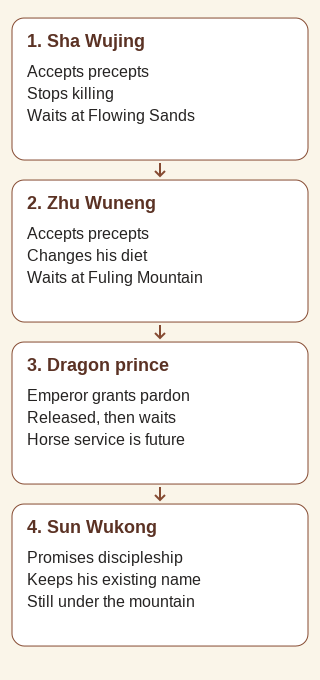
For each speaker’s promise and unresolved detail, continue to the four recruitment encounters.
↑ On this pageWhy this chapter changes the novel’s direction
Chapter 7 ends with Wukong contained. Chapter 8 asks what containment could lead to. Instead of introducing another contest to defeat him, the story offers him a future role serving someone else. Similar arrangements link two violent monsters and a condemned dragon to a journey whose principal traveller has not even been found.
Guanyin works across different kinds of authority. The Buddha gives the mission; Guanyin evaluates encounters and accepts commitments; the Jade Emperor must grant the dragon’s pardon. These roles are distinct within the story. Calling every action simply “divine rescue” loses the difference between a promise, a change of conduct and a completed order.
Nor is the mission built only on willing affection. The Buddha’s instructions for the bands include severe pain if a powerful disciple refuses direction. The chapter places persuasion and coercion beside each other. That tension helps a reader ask what obedience and reform mean in this fictional religious undertaking; it should not be turned into advice for controlling real people.
At Chang’an, Guanyin and Hui’an appear as afflicted wandering monks, take temporary lodging in a local deity’s shrine and tell the gods to keep their presence secret. The final sentence leaves the identity of the seeker unresolved. The endpoint is preparation for a search, not a completed team departing west.
A useful one-sentence takeaway is: Guanyin prepares the westward pilgrimage by travelling east, arranging conditional future help and beginning the search for its seeker. The text has moved from Wukong’s rebellion to the conditions for a shared undertaking.
↑ On this pageThree checks for your chapter notes
These are invented note-editing examples, with answers grounded in the chapter. They are not reports of classroom tests or reader behaviour.
1 · Correct the direction and forecast
A draft note says: “Guanyin searches west for the monk and takes exactly three years to reach Chang’an.” What needs changing?
Show the correction and reason
Guanyin goes east to find the seeker. Her two-to-three-year estimate answers Jinding’s question about when the seeker might reach his location. Her explicit uncertainty and the different traveller rule out an exact duration for her own trip.
2 · Separate names from future roles
A character card says: “Guanyin gives four recruits new Wu names and immediately turns the dragon into a horse.” Which changes are actually narrated?
Show the correction and reason
Sha Wujing and Zhu Wuneng receive names. Wukong retains his existing name, and the dragon receives no new Wu name in this chapter. The dragon is pardoned and released, then waits for the seeker; his transformation into a horse is still a future arrangement.
3 · Keep the ending unresolved
A summary ends: “Guanyin frees Wukong, meets the monk and sends the completed group on its journey.” How should the endpoint be rewritten?
Show the correction and reason
Wukong promises to serve but remains beneath the mountain. Guanyin reaches Chang’an in disguise and searches secretly for the seeker. The chapter ends before that person is found, so rescue, assembly and departure cannot be listed as completed events here.
Sources and text boundaries
This summary follows the complete Chapter 8 digital Chinese text linked below, including its framing and ending. Short Chinese quotations and English explanations are checked against that text. It does not collate printed editions, reproduce a modern translation or establish historical religious facts. Adaptations and abridgments may arrange material differently.
- Wikisource · 西遊記, Chapter 8Primary digital text for mission instructions, gifts, all four encounters and the unresolved Chang’an ending.