Chapter 6 at a glance
Chapter 6 turns Heaven’s unsuccessful siege into Wukong’s capture. Guanyin arrives at the disrupted Peach Banquet, asks what happened, sends her disciple Hui’an to investigate, and recommends Erlang Shen when the renewed battle fails. Erlang pursues Wukong through changing forms. Laozi’s ring, Erlang’s dog and the combined fighters finally bring him down.
The chapter ends with an order to execute Wukong. It does not narrate his death. The next chapter tests whether that sentence can be carried out. Keep this ending distinct from the furnace and Five Elements Mountain, which belong to chapter 7.
The chapter heading pairs Guanyin’s inquiry with the “Lesser Sage” subduing the “Great Sage.” That prepares a change in method: Heaven needs information, a specially summoned opponent and coordinated help. It does not make every character’s confident prediction an already completed event.
↑ On this pageFrom Guanyin’s inquiry to Erlang’s summons
Guanyin encounters a ruined banquet rather than a celebration. The Jade Emperor gives her his account of Wukong’s appointments, thefts and return to the mountain. Read it as a report delivered by a character, not as an extra scene in which those earlier actions happen again.
Hui’an, also identified in this chapter as Muzha and Li Tianwang’s second son, visits the camp. Li explains the previous day’s battle: some allied creatures have been captured, but Wukong and his monkeys remain at large. When Wukong challenges the camp again, Hui’an fights him for fifty or sixty exchanges, tires, retreats and returns with the request for help.
Guanyin then recommends the Jade Emperor’s nephew, Erlang Shen, based at Guankou. Her phrase “聽調不聽宣” distinguishes a military summons he will answer from a court summons he does not ordinarily attend. Heaven accordingly issues the deployment order. This is a specific relationship with authority, rather than a picture of Erlang always waiting obediently inside the heavenly court.
Erlang brings his six sworn brothers and troops. He asks Heaven’s forces to keep the encirclement tight around the sides but leave the top clear for the contest. He also asks Li Tianwang to hold the demon-revealing mirror aloft, so a fleeing Wukong can be located. That mirror will matter when disguise turns into escape.
↑ On this pageWhy the duel becomes a chase
Wukong and Erlang trade insults before fighting. Erlang names Wukong’s earlier Bimawen post; Wukong answers with a taunt about Erlang’s family. Their words expose sensitivities, but insults do not settle the fight.
After more than three hundred exchanges the narrator says the outcome is undecided. Both enlarge their bodies and weapons. Meanwhile the six brothers attack the monkey camp, scattering its defenders. Wukong sees that disruption, becomes anxious, ends his enlarged form and runs.
The distinction matters: a tied duel, a successful attack on troops and the retreat of their leader are three different observations. Calling Erlang the final captor does not turn the earlier duel into a narrated one-on-one victory. The camp’s collapse creates the immediate opening for pursuit.
↑ On this pageThe route from disguise to capture
Swipe the table on a phone, or focus it and use the arrow keys.
| Stage | What happens | Keep separate |
|---|---|---|
| Inquiry | Guanyin sends Hui’an; he returns after losing his encounter. | Reporting the problem is not capturing Wukong. |
| Deployment | Erlang brings six brothers; Li takes the mirror position. | A plan and an assembled force are not yet success. |
| Duel and camp | The duel remains undecided while the monkey camp scatters. | Wukong’s alarm explains his retreat. |
| Animal forms | Wukong and Erlang change forms; behaviour and observation reveal clues. | There is no single universal detection explanation. |
| Temple disguise | Wukong’s tail becomes an awkward pole behind the building. | Erlang recognizes the mismatch and threatens its openings. |
| Guankou impersonation | Li’s mirror finds the invisible route; Wukong impersonates Erlang. | A deceived temple staff does not mean the pursuer is deceived. |
| Combined capture | Laozi’s ring hits, the dog pulls Wukong down, seven restrain him. | Success depends on successive contributions. |
| Heavenly custody | Wukong is bound and brought up; Heaven orders execution. | His fate under that order remains unanswered here. |
The chase moves through birds, water and land before Wukong becomes a temple. In the water episode both rivals look for an animal whose appearance or reaction does not fit. At the temple, the tail has not vanished: it becomes the pole whose placement gives the disguise away. Read the complete disguise and counter sequence for the individual changes.
After that escape, Li’s mirror locates Wukong’s invisible journey toward Erlang’s own base. Wukong arrives disguised as Erlang and is admitted by the temple attendants. The real Erlang returns, and the rivals fight back toward Flower-Fruit Mountain. The impersonation adds a jurisdiction joke: Wukong claims the temple now belongs to Sun, while its rightful master is chasing him.
↑ On this pageWhat finally stops Wukong—and what the ending leaves open
Guanyin suggests throwing her bottle to knock Wukong down. Laozi advises her against risking it and throws his own ring instead. The proposal and the performed action must stay separate. The ring strikes Wukong’s head; he falls, gets up and runs. Erlang’s dog bites his leg and pulls him down again. Erlang and the six brothers then restrain and bind him, preventing further transformations.
This is coordinated capture, not an isolated test of who has the strongest weapon. Erlang modestly credits divine favour and the gods’ power when others congratulate him. He directs his brothers to remain and search the mountain, while heavenly soldiers escort the prisoner and he reports above. Even the escort and the report have different responsible actors.
The Jade Emperor orders Wukong taken to the execution platform. The closing suspense asks what will happen to his life; it does not announce that execution succeeded. Continue to chapter 7’s punishment and containment sequence for that answer.
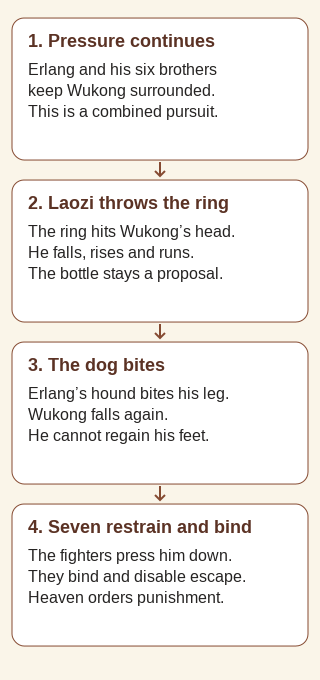
A useful interpretation is that the chapter changes the problem from an unconstrained rebel to a prisoner whose body still needs to be dealt with. The text supports that transition through the capture chain and execution order. It does not require calling Wukong morally converted or permanently powerless.
↑ On this pageThree chapter 6 corrections
These are original reading exercises, not quotations or reader case reports. Try the correction before opening the answer.
Was the first duel already decided?
A note says Erlang wins the three-hundred-exchange duel and Wukong immediately flees. Correct the causal sequence.
Show answer
The narrator leaves that duel undecided; the attack on the monkey camp makes Wukong anxious and he retreats.
The final group capture is later. Do not transfer its outcome backwards to an earlier stage.
Who throws the bottle?
A note says Guanyin’s bottle knocks Wukong down before the dog bites him. Identify the proposed and actual actions.
Show answer
Guanyin proposes the bottle throw, but Laozi throws the ring that hits Wukong.
The dog then trips the fleeing Wukong, and seven fighters restrain him. Speaker intention and performed action are different evidence.
Where should the summary stop?
A note ends chapter 6 with the furnace and Wukong already beneath Five Elements Mountain. Set the correct boundary.
Show answer
Stop at capture, heavenly custody and the order for execution.
The furnace and mountain are chapter 7 events. This chapter deliberately leaves the success of the execution order unresolved.
Sources and text boundaries
Spoilers are limited to the chapters named here. This is an English reading companion to the cited Chinese digital transcription, not a translation, critical edition or complete survey of later episodes. Fictional divine bodies, weapons and punishments are story claims.
- Journey to the West, Chinese chapter 6 (current Wikisource transcription)The complete chapter was read; the guide uses original English explanation, with scene facts distinguished from interpretation.