Practical guide
Why Wukong Survives the Furnace—and How He Gets Fiery Eyes
Chapter 7 places Wukong in the furnace’s Xun position, where its wind-and-fire account lets him avoid flame but exposes his eyes to smoke. The 49 days end at Laozi’s opening of the furnace; his resistant body was already explained before that.
On this page · 6 sections
Wukong’s body resists punishment before he enters the furnace
In Journey to the West chapter 7, Wukong survives the furnace by taking the Xun position described in the story as wind without flame. Smoke nevertheless troubles and reddens his eyes, which the narration connects with the name “fiery eyes and golden pupils.” Forty-nine days later, Laozi opens the furnace to recover elixir, and Wukong jumps out.
That sequence begins with a resistant body, not an ordinary body that the furnace first makes immortal. At the chapter’s opening, blades, fire and thunder have already failed to injure him. Laozi attributes this resistance to Wukong’s earlier consumption of peaches, imperial wine and stolen pills, including pills at different stages of preparation, worked together within his body.
Those are the novel’s narrated and spoken explanations. The distinction helps follow the plot without treating supernatural alchemy as a real account of human physiology. The guide stays within this Chinese chapter 7 transcription; it does not establish every sight ability attributed to Wukong elsewhere.
Laozi intends to recover his pills and destroy the prisoner
Laozi proposes the furnace because immediate punishment cannot damage Wukong. He expects the furnace’s fires to extract his elixir and reduce Wukong to ashes. The Emperor transfers Wukong to him. At the palace Laozi removes the bindings and the restraint used after the chapter 6 capture, then pushes him into the furnace and orders its attendants to raise the fire.
The proposal is an intended remedy to a failed execution. It is not a reward, a training course Wukong requests or a success guaranteed by the narration. What Laozi hopes to obtain must be read separately from what happens inside.
Xun keeps flame away in the account, but not smoke
The narration lists the furnace’s eight trigram positions, then specifically locates Wukong under Xun. It explains Xun as wind and says that where there is wind there is no fire. The wind stirs smoke, however, and his eyes become red and chronically troublesome.
巽乃風也,有風則無火The next sentence introduces the smoke, so stopping at “no fire” leaves out the consequence that matters. The name 火眼金睛 follows that description of his eyes. At the later opening he is rubbing them and shedding tears before he sees light and escapes.
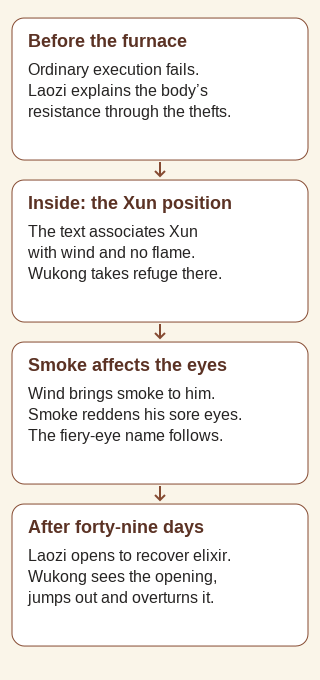
The figure is a causal reading aid, not a diagram of a reconstructed historical furnace. “Xun” names the position in the passage; it does not identify a measured compass location or a reproducible method of surviving fire.
What the forty-nine days count
The narration says seven times seven—forty-nine—days pass until Laozi’s firing is complete. He opens the furnace to take out elixir. Wukong hears the opening, sees light, leaps out, overturns the furnace and throws aside those trying to restrain him. Laozi’s attempt to catch him also fails, and Wukong retrieves his staff.
On a small screen, swipe within the table, or focus it and use the arrow keys.
| Stage | What the text says | What it does not establish |
|---|---|---|
| Before entry | Execution fails; Laozi explains resistance through the earlier consumed substances | The furnace is not the first place where resistance appears. |
| Inside the furnace | Wukong takes the Xun position; wind avoids flame but brings smoke | Avoiding flame does not mean the whole ordeal is harmless. |
| At forty-nine days | Laozi finishes the firing and opens to recover elixir | This number does not date the later mountain imprisonment. |
| After the opening | Wukong jumps out and renews the disturbance | Escape does not fulfill Laozi’s intended destruction or prove moral reform. |
The number belongs to a stated interval inside this chapter. Converting it through the earlier Heaven-and-mountain dialogue into an exact earthly calendar date would require a time relation and starting date this passage does not supply.
Survival changes the problem without solving it
After the escape, Wukong reaches Tongming Hall and the area outside Lingxiao Hall. Wang Lingguan blocks him, and their fight remains undecided; thirty-six thunder generals then surround him but cannot approach. The Emperor sends messengers to ask Buddha for help.
These named events matter because “he escapes the furnace” is not the end of the chapter. Ordinary execution has failed, the furnace has failed, and further armed containment cannot finish the problem. The next change is the palm wager, whose test uses a boundary rather than a furnace.
The altered eyes belong to the cost and consequence of this sequence. The chapter alone is insufficient to prove a claim about every demon he can detect in every later episode; such a question needs its own later passages.
Three corrections to common furnace summaries
These invented reading sentences test cause, timing and chapter scope.
Case 1
“Wukong enters as mortal and the furnace first makes his body invulnerable.” Which earlier event contradicts that?
Show answer and explanation for case 1
Execution methods have already failed before the furnace; Laozi offers an explanation of that resistant body.
Keep the pre-entry explanation separate from the new eye consequence. Survival in the furnace is not the first resistant-body event in this chapter.
Case 2
“Forty-nine days tell us exactly when he is released from the mountain.” What does that number actually end?
Show answer and explanation for case 2
The furnace firing, when Laozi opens to recover elixir.
The mountain follows later. This passage supplies no date for rescue from it.
Case 3
“No flame reaches his refuge, so the ordeal causes no injury.” Which narrated effect is omitted?
Show answer and explanation for case 3
Wind brings smoke that reddens and troubles his eyes.
The passage explicitly connects the altered eyes and their name with that effect. Avoiding the flame does not erase the smoke.
Sources and further reading
- Chinese Wikisource: Journey to the West, chapter 7Current complete Chinese digital chapter read. English explanations and short glosses here are original; no printed-edition collation or modern-translation comparison is claimed.