Practical guide
Buddha’s Palm Wager: Why Wukong’s Five Pillars Do Not Prove Escape
The wager requires Wukong to leave Buddha’s right palm. His five pillars, inscription and return do not prove that: the writing reappears on the right middle finger. The story separates a travelled route from a successfully crossed boundary.
On this page · 6 sections
The winning condition is outside the palm
Sun Wukong loses Buddha’s palm wager in Journey to the West chapter 7 because he never gets outside the right palm. He believes he has reached the end of the world, marks a pillar and returns to claim victory. Buddha shows the same inscription on his right middle finger, revealing that the supposed far boundary was still part of the palm.
The test is not “go a very long way and come back.” Buddha specifically asks whether Wukong can get outside his right hand with a somersault. Wukong’s confidence comes from his claimed cloud-leap range and the palm’s apparently small size, but those observations do not establish the boundary of the space he is entering.
This guide reconstructs that proof problem from the captured Chinese chapter 7. Its English explanation is original. The novel’s extraordinary spatial transformation is not presented as a physical measurement or a claim that a real person’s hand contains the world.
The promises belong to the fictional wager
Buddha says that if Wukong wins, the Emperor can move to the West and Heaven can be given to him, ending the armed struggle. If Wukong cannot get out, he is to return below and cultivate further before disputing the throne. Wukong asks whether Buddha can make the promise binding; Buddha says he can and extends his right hand.
Those terms explain why Wukong thinks proof of success will entitle him to the throne. They are promises in a dialogue, not actions already performed: neither the Emperor’s move nor Wukong’s accession occurs when the wager is spoken.
Wukong turns landmarks into a claim of arrival
Wukong stands in the palm and travels on the somersault cloud. He sees five flesh-red pillars supporting a blue-green vapour. He declares this the road’s end. To have something to show Buddha, he turns a hair into a brush and writes a line recording the Great Sage’s visit on the middle pillar. He also leaves urine at the foot of the first pillar, then returns.
The landmarks are described; “the world’s end” is Wukong’s inference about them. The inscription and bodily trace mark where he has been, but neither independently proves that this location lies outside the palm. His argument needs the very boundary identification he has assumed.
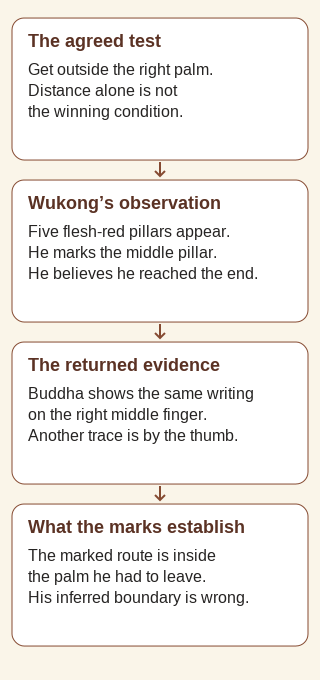
The diagram separates the observed landmark, the interpretation and the later check. It does not deny that the story narrates a journey; it explains why that journey does not satisfy the agreed test.
Buddha redirects attention to the marks in his hand
On a small screen, swipe within the table, or focus it and use the arrow keys.
| Stage | Wukong’s position | What the later check establishes |
|---|---|---|
| Agreed test | He expects to leave a small-looking palm easily | Success depends on getting outside it, not on perceived size. |
| Five pillars appear | He calls them the end of the road | He has not independently established that this is outside the hand. |
| He marks the middle pillar | The inscription is meant as proof of his visit | A location mark needs a correctly identified location to prove escape. |
| Return to the palm | He demands that the Emperor yield Heaven | Buddha says he has not left and asks him to look down. |
| Inscription and other trace are shown | He is astonished and suspects an extraordinary explanation | Writing is on the right middle finger; the other trace is near the thumb. |
The narrator explicitly names Buddha’s right middle finger for the writing. The thumb area carries the second trace. A summary that says only “Buddha laughs” loses the evidence that answers Wukong’s challenge to go and check the pillars.
The reader is given two views of one marked path: Wukong’s apparent distant destination and the revealed features of the hand. The conclusion “still in the palm” follows the story’s identification, not an invented calculation of ordinary hand size divided by travel distance.
A second attempted jump does not reverse the verdict
Wukong expresses disbelief and tries to jump again. Buddha turns his palm and pushes him out beyond the western gate, changing the five fingers into five linked mountains named for metal, wood, water, fire and earth. Wukong is pressed beneath them.
The attempt happens after the returned evidence has exposed his first journey. It is not narrated as a successful second wager. Mountain confinement follows this failed attempt; the seal and appointed watchers come later still. For those steps, read the continuing punishment guide.
A useful interpretation is that Wukong’s method of proving freedom has mistaken the system within which it operates. That is a reading of the scene, not the only possible philosophical account of Buddha or an authoritative Buddhist teaching.
Three proof checks
Each sentence below is an original mistaken reading, followed by the narrower conclusion the scene supports.
Case 1
“Wukong travels far and comes back, which proves he left the palm.” What condition is missing?
Show answer and explanation for case 1
The test requires crossing outside the palm, not merely completing a journey.
A great perceived distance can still lie within the space under test. The revealed writing identifies the supposed distant pillar with the middle finger.
Case 2
“Five pillars objectively establish the edge of the world.” Whose inference is this?
Show answer and explanation for case 2
Wukong’s inference when he sees them.
Their appearance is narrated, but his interpretation of them as the road’s end is later overturned by the returned evidence.
Case 3
“Wukong wins when he jumps a second time.” What follows the attempt?
Show answer and explanation for case 3
Buddha turns the palm and presses him beneath the five linked mountains.
The story gives an attempted repeat, followed by restraint, rather than a new successful escape.
Sources and further reading
- Chinese Wikisource: Journey to the West, chapter 7Current complete Chinese digital chapter read. English explanations and short glosses here are original; no printed-edition collation or modern-translation comparison is claimed.