Journey to the West · Chapter 8
Guanyin’s Four Recruitment Encounters
Guanyin meets Sha Wujing, Zhu Wuneng, the dragon prince and Wukong separately. Compare two new names, a pardon and promises that leave the helpers waiting.
On this page · 6 sections
Four encounters prepare help; they do not assemble the whole party
On her eastward search in chapter 8, Guanyin encounters the future helpers in this order: Sha Wujing, Zhu Wuneng, the dragon prince and Sun Wukong. Hui’an accompanies her. These are separate meetings along the route, not four introductions in an already travelling pilgrim party.
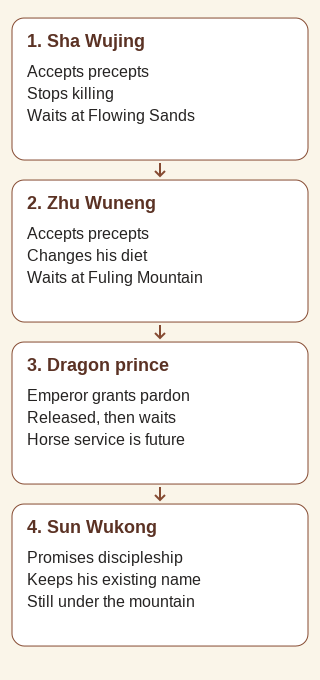
Each encounter changes a different condition. The first two figures accept precepts and wait. The dragon is pardoned and released, then waits for a future role as a white horse. Wukong promises to become a disciple but remains under the mountain until the future seeker can free him.
Spoiler boundary: the comparison stops at the end of chapter 8. It does not supply the later departure order, the final rewards or a complete later explanation of the floating skulls.
Compare the meetings in the order Guanyin travels
Keep “what this figure reports,” “what Guanyin arranges” and “what happens now” in different columns. A report about a former offense is not itself the newly performed action in the encounter.
On a small screen, swipe inside the table, or focus it and use the arrow keys.
| Encounter | Prior condition described | Change established here | Action still pending |
|---|---|---|---|
| Sha Wujing at Flowing Sands | He identifies himself as the former curtain-lifting general, punished after breaking a glass vessel; he describes killing travellers for food | He accepts precepts, receives the name Sha Wujing, stops killing and waits; Guanyin promises relief from the recurring sword punishment | Meeting and accompanying the future seeker; the announced future use of the nine skulls |
| Zhu Wuneng at Fuling Mountain | He identifies himself as the former Tianpeng Marshal, punished after drunken conduct toward Chang’e and reborn in a pig’s body | He accepts precepts and the name Zhu Wuneng, changes his diet and waits | Meeting the seeker and undertaking the westward service |
| The dragon prince encountered suspended in the air | He says he is the son of the Western Sea Dragon King Ao Run and faces execution after burning the palace pearl | Guanyin petitions the Jade Emperor; pardon and release are actually narrated; she places him in a ravine | The seeker’s arrival and transformation into a white horse for the journey |
| Sun Wukong at Five Elements Mountain | He remains confined and says he has repented after more than five hundred years | He promises discipleship and keeps his existing name; Guanyin promises to send the future seeker | Release by that seeker and the later journey |
The table deliberately does not label all four as “released.” Pardon and physical release are narrated for the dragon. Wukong receives a future rescue arrangement, while the first two change conduct and remain waiting at their places.
Two new names make an existing name significant
Guanyin gives the Flowing Sands figure the surname Sha and the religious name Wujing. At Fuling Mountain she gives the piglike figure the surname Zhu and the religious name Wuneng. The chapter uses 沙悟淨 and 豬悟能 for these naming acts.
Use “Zhu Wuneng” in a note about this particular naming scene. The site’s Zhu Bajie guide is the corresponding broader character route, but chapter 8 does not narrate Guanyin naming him “Bajie.” Do not replace the actual scene’s name with a familiar label and then claim it was newly given here.
When Guanyin offers Wukong a religious name, he answers that he already has one: Sun Wukong. She notices that its 悟 matches the two figures she has already brought into the arrangement. The scene connects three names; it does not show her inventing Wukong’s name or giving the dragon a third new “Wu” name.
This is a small but useful distinction between newly named, existing name recognized and no new personal name supplied here. A single “Guanyin names the disciples” summary obscures it.
Why the dragon’s rescue differs from Wukong’s
The dragon reports a death sentence imposed by the Jade Emperor. Guanyin therefore goes to that authority, asks that his life be spared and proposes him as the scripture seeker’s means of transport. The Emperor grants the pardon and orders his release. Only after that does Guanyin put him in the ravine to wait.
Wukong is a different case. At the mountain Guanyin does not remove Buddha’s seal or take him out of the stone confinement. She says that after finding a seeker in the Tang lands, she will have that person rescue him. Wukong’s agreement is real within the scene; the rescue is still future.
Two supported observations follow. Guanyin uses different forms of authority for different conditions, and a promise of rescue can reorganize a character’s future without changing the present physical confinement. Neither observation requires a claim about who is “stronger” or an invented contest between the deities.
The promised white-horse role needs the same caution. Chapter 8 says the dragon will wait for the seeker and become a white horse. It does not narrate that transformation as already completed at this encounter.
Nine skulls: preserve the claim and its unresolved use
Sha Wujing says that he has killed many travellers, including scripture seekers. Ordinary victims’ heads sank, he says, but nine skulls belonging to scripture seekers floated. He threaded them together as strange objects. The source presents this explanation in his own speech.
Guanyin tells him to hang the skulls around his neck and wait for the seeker because they will have a use. Chapter 8 does not yet explain that use. It also does not identify all nine as named reincarnations of the same person. A note that supplies those conclusions has moved beyond this passage.
The safer record is: reported origin → nine floating skulls → instruction to keep them → future purpose unresolved. Leaving the final field open gives you an exact question to check when a later chapter returns to the object.
Open the editable encounter and promise card. It includes a completed dragon-versus-Wukong comparison and a blank entry for another scene.
Check three summaries of the recruitment
The three notes below are hypothetical practice examples. Check each against the chapter’s wording before opening the explanation.
Case 1
“Guanyin frees the dragon and Wukong, and all four leave with her.” Which parts need correction?
Show answer and explanation for case 1
The dragon is pardoned and released, then waits in a ravine. Wukong remains under the mountain awaiting the seeker; the other two also wait rather than departing as a group.
A promise changes future expectations. Only a narrated release establishes present freedom, and neither release nor agreement automatically establishes travel with Guanyin.
Case 2
“Guanyin gives Sun Wukong his name because she has already named three other Wu disciples.” What does the scene say?
Show answer and explanation for case 2
She has newly named Sha Wujing and Zhu Wuneng. Wukong already has his name, and she retains it because 悟 matches those two.
The dragon is not given a new Wu personal name here. Keep the number of prior naming acts separate from the total of future helpers.
Case 3
“The nine skulls have already been used to carry the pilgrim across the river.” Is that a chapter 8 event?
Show answer and explanation for case 3
No. Sha describes the floating skulls, and Guanyin says to keep them for a future use. The seeker has not yet arrived.
An announced later purpose is not a completed action. Record the open question and check the later source passage instead of filling it from memory or an adaptation.
Sources and further reading
- Chinese Wikisource: Journey to the West, chapter 8Complete current Chinese digital chapter read. Short Chinese anchors and original English glosses identify this reading; printed editions and modern English translations have not been collated.