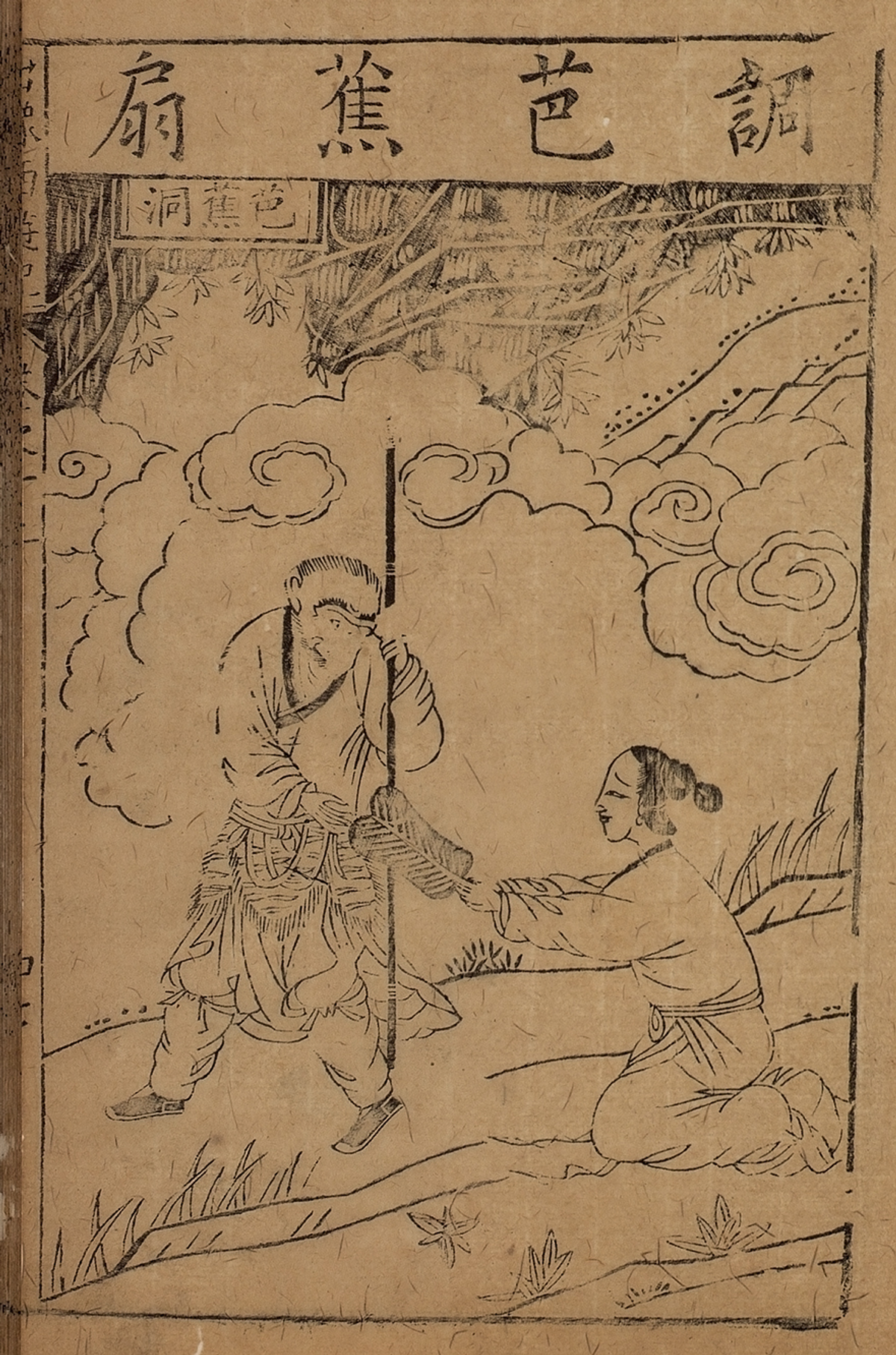
Sun Wukong in Journey to the West: before the role judgment
Sun Wukong is the easiest Journey to the West figure to recognize and one of the easiest to misread. He is not only the Monkey King mascot. He is rebellious power that must become disciplined movement: clever, violent, comic, loyal, impatient, and repeatedly redirected by Tang Sanzang, Guanyin, and the pilgrimage task.
Start with disciplined rebellion
Sun Wukong matters because his brilliance is unstable. He can defeat monsters, mock heavenly order, protect Tang Sanzang, and wreck the same discipline he serves. The useful first question is not how strong the Monkey King is, but who or what can make his power serve the journey.
Monkey King is not the whole role
The name Monkey King gives readers a fast memory hook, but it can hide Sun Wukong's changing position: rebel, prisoner, disciple, protector, trickster, and problem-solver. If a page treats the name as enough, it misses why the novel keeps testing his obedience.
Tang Sanzang makes strength difficult
Tang Sanzang is not stronger than Sun Wukong in battle, but he changes the meaning of strength. Their relationship turns combat power into a moral and procedural problem. Sun Wukong often sees the danger first, yet he still has to move within a pilgrim order that restrains him.
Guanyin supplies the rescue frame
Guanyin matters because Sun Wukong's story is not solved by cleverness alone. Help, punishment, instruction, and rescue often arrive through a larger Buddhist and heavenly structure. When Wukong cannot simply smash the problem, the page should ask what kind of authority redirects him.
Adaptations amplify the wrong shortcut
Films, games, cartoons, and retellings often magnify Wukong's swagger, staff, speed, and comic violence. Those memories are useful entry points, but they can erase the novel's slower pattern: power repeatedly being trained by pilgrimage, relation, rescue, and restraint.
Do not rank him like a superhero
Power ranking makes Sun Wukong smaller. The better reading asks when strength works, when it creates trouble, when trickery substitutes for force, and when submission becomes part of victory. His importance lies in tension, not only invincibility.
Choose the Wukong problem
Open chapter one when origin memory is the issue. Open Journey religion when discipline and rescue are confusing. Open Monkey King adaptation when media memory is crowding out the novel. Open the full Journey guide when Wukong needs the pilgrimage frame around him.
Flower-Fruit Mountain establishes the first claim
The opening Sun Wukong material is not only an origin story for a powerful fighter. Flower-Fruit Mountain gives him a community, a kingship claim, and a reason to treat recognition as something he can seize. The stone birth and waterfall-cave episode make ability visible before any institution gives him a title. That sequence matters because later conflict with Heaven is not a sudden personality change. It extends the first question: what happens when extraordinary capacity refuses to accept a place assigned by others? Read the early names and titles as stages in a political and emotional argument, not as collectible lore.
Immortality turns fear into ambition
Sun Wukong's search for immortality begins from fear of death inside an otherwise triumphant community. The journey to a teacher, the acquisition of techniques, and the desire to escape ordinary limits show that rebellion has an anxious text. He does not seek knowledge only for contemplation; he wants protection from vulnerability and a status that cannot be revoked. This helps a reader distinguish curiosity from accumulation. When a later episode displays another power, weapon, or transformation, ask whether it serves the pilgrimage task or returns to the earlier wish to become ungovernable.
Heavenly titles expose the recognition trap
The conflict with Heaven can be read as a comic spectacle, but its structure is about recognition, office, and insult. A title may acknowledge Sun Wukong while also placing him low in an order he does not respect. His reaction shows why formal inclusion does not settle the problem of dignity. The useful reading question is not whether Heaven should have promoted him faster. It is how a system tries to absorb disruptive power through rank, and how Sun Wukong mistakes title, freedom, and equality for the same thing. This keeps the episode connected to character rather than reducing it to a power-ranking tournament.
The headband makes obedience bodily
Pilgrimage discipline is not an abstract moral improvement. The controlling spell makes conflict between Sun Wukong and Tang Sanzang immediate and bodily. Tang Sanzang depends on a protector whose judgment he often mistrusts; Sun Wukong serves a master whose compassion can look naive in dangerous situations. The device therefore creates an uneasy relationship among authority, pain, protection, and interpretation. A careful reading should not celebrate punishment as a simple cure for rebellion or dismiss discipline as irrelevant cruelty. Ask what each use reveals about trust and about the group's inability to coordinate through persuasion alone.
Recognition is often more important than combat
Many monster episodes are not solved by force alone. Sun Wukong must identify disguise, trace an opponent's origin, test a claim, seek help, or recognize that a weapon and its owner belong to a larger heavenly or religious network. His transformations and sharp perception matter because the pilgrimage world is full of misleading appearances. This changes the character guide's practical focus. Instead of asking only whether he can defeat an enemy, ask what he sees before the others, what example he cannot communicate, and why outside authority is needed to finish a problem that his strength has already exposed.
Tang Sanzang tests judgment as well as loyalty
Sun Wukong's loyalty is difficult because obedience and protection can point in different directions. Tang Sanzang may order restraint when Sun Wukong perceives danger, while Sun Wukong may use violence or deception in ways the monk cannot accept. The relationship asks whether correct perception excuses every method and whether compassionate intention survives without practical judgment. Track who has better information, who controls the choice, and who bears the consequence. This approach avoids two shortcuts: treating Tang Sanzang as merely foolish and treating Sun Wukong's tactical accuracy as proof that every response is morally complete.
Guanyin connects punishment, rescue, and mission
Guanyin repeatedly links Sun Wukong's individual ability to a religious and institutional mission. Her role helps explain why the pilgrimage is not simply a road adventure held together by friendship. Recruitment, constraint, intervention, and rescue place the group inside a larger structure of vows and assistance. When Guanyin appears, ask what the protagonists could not resolve within their own relationships. The answer may involve knowledge, legitimacy, a monster's history, or the limits of force. This gives the guide a stronger religious limit without claiming that every episode has one fixed doctrinal interpretation.
Comedy prevents discipline from becoming a straight line
Sun Wukong does not move from rebel to obedient disciple in a smooth moral arc. Boasting, irritation, appetite for contest, verbal play, and impatience remain active. Comedy preserves those tensions and prevents the character from becoming a solemn example of improvement. A comic exchange can still reveal hierarchy, fear, affection, or strategic insight. Notice who is allowed to mock whom and when humor releases pressure inside the group. The persistence of comic rebellion is part of the character's continuity: discipline redirects his energy, but does not erase the intelligence and excess that made him recognizable.
Adaptation comparison needs a return-to-text test
A later film, game, animation, or novel may foreground the staff, transformations, heavenly rebellion, romance, tragedy, or solitary heroism. Those choices can be artistically coherent without serving as example for the older novel. Use a return-to-text test: identify the adaptation's strongest emphasis, find the closest relationship or episode in the novel, and state what the adaptation removes or rearranges. This keeps adaptation memory useful rather than embarrassing. The goal is not to police every Monkey King retelling, but to stop its emotional center from silently replacing the pilgrimage group's relationships.
A character claim should name an episode pressure
A reliable Sun Wukong paragraph should connect a trait to a pressure that activates it. Rebellion means something different at Flower-Fruit Mountain, in the heavenly bureaucracy, under confinement, or inside pilgrimage discipline. Cleverness means something different when it wins status, detects disguise, protects Tang Sanzang, or seeks help from a higher authority. Write the scene pressure before the trait and the consequence after it. This prevents a list of powers from masquerading as character analysis and gives the reader a repeatable method for later chapters.
The arc changes function without erasing continuity
It is tempting to describe the pilgrimage as a complete conversion from wild rebel to obedient protector. The novel keeps more continuity than that formula allows. Pride, impatience, verbal aggression, tactical brilliance, sensitivity to insult, and delight in transformation remain available. What changes is the function those qualities serve and the relationships that answer them. The arc is therefore best read as repeated redirection under pressure. Sun Wukong becomes more capable of serving a shared path, but the path remains interesting because his older energies have not disappeared.