Practical guide
What Heaven Knows About Wukong: Reports in Chapter 5
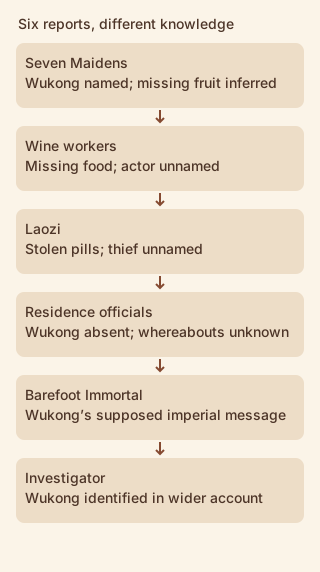
Readers see Wukong’s acts before Heaven hears six different reports. Compare who names him, who reports an unknown thief, who describes absence and what the later investigation adds; preserve the maidens’ qualified invitation answer.
Reader knowledge is not automatically a witness’s report
Chapter 5 shows readers Wukong stealing peaches, deceiving the Barefoot Immortal, drinking the banquet wine and eating Laozi’s pills. The Heavenly Court does not receive all of that in a single eyewitness account. It hears several reports with different knowledge, followed by an investigating official’s wider identification.
Separate three fields in a note: what the narration shows; what this reporter says; what identifies Wukong at this point. Reports naming him, reports about an unnamed thief, and reports of his absence are different evidence. Their sequence matters.
The maidens’ invitation answer is qualified
Before the thefts at the banquet, Wukong asks the Seven Maidens who has been invited. They list the traditional classes of guests. When he asks whether he is invited, their answer is 不曾聽得說—“we have not heard that said,” our original gloss. They then explain that this is the old rule and that they do not know the present gathering’s arrangements.
That is narrower than a complete official guest list or a declaration that the Emperor has deliberately excluded him. Wukong later tells his followers that he was not invited; preserve that as his account. A reading can explore his sense of exclusion without replacing the maidens’ qualified answer with a certainty they never claim.
Six reports and what each one establishes
On a small screen, swipe within this table, or focus it and use the arrow keys.
| Reporter and route | What is reported | Does this report name the actor? | Limit to preserve |
|---|---|---|---|
| Seven Maidens to Queen Mother; Queen Mother relays their account to the Emperor | Wukong immobilized them; ripe large peaches are missing | Yes, for the confinement; missing peaches are attributed as an inference | They describe what they found and what they think happened, not witnessing every ripe peach being eaten |
| Wine-making workers and officials to the Emperor | Someone disrupted the banquet and consumed wine and food | The quoted report says they do not know who | Do not copy the reader’s earlier view of Wukong into their report |
| Laozi to the Emperor | Prepared elixir pills have been stolen | The report calls the actor a thief without naming Wukong | Reporting missing pills does not make Laozi an eyewitness to the theft |
| Great Sage residence officials to the Emperor | Wukong has been out since the previous day and has not returned | Yes, about absence | Absence and unknown whereabouts are not a direct observation of drinking or pill theft |
| Barefoot Immortal to the Emperor | Wukong told him that an imperial order required a detour for the ceremony | Yes | He reports the message he received; the narration had already shown Wukong inventing it |
| Investigating official to the Emperor after inquiries | Wukong is the one disrupting Heaven; preceding matters are recounted | Yes, as a wider identification | The narration summarizes the inquiry; it does not reproduce an interview log |
The Emperor already has Wukong’s name in several earlier reports. The investigating official is therefore not the first person to name him. His report supplies the broader identification after the court has heard piecemeal complaints. Keep that distinction when summarizing the investigation.
Two places where readers know more than a reporter
On a small screen, swipe within this table, or focus it and use the arrow keys.
| Narration available to the reader | Later reporter’s position | Accurate reading note |
|---|---|---|
| Wukong makes sleep creatures that put the banquet workers to sleep, then drinks | Workers report the missing wine and food but say they do not know the actor | The reader saw the action; the workers’ report remains unnamed |
| Wukong invents a supposed imperial instruction and diverts the Barefoot Immortal | The immortal initially takes the message as true and later reports it | The deception is narrated; the reported message is not proof that an actual imperial order existed |
Laozi’s own scene has another limit: the narration places him and his attendants elsewhere when Wukong enters the pill room. His later discovery of theft should not become a sentence saying that he watched Wukong eat the pills. Identify the location of the knowledge, not merely the person associated with the object.
Accusation and admission arrive later in the sequence
After the investigation, Heaven sends its forces to Flower-Fruit Mountain. The Nine Luminaries accuse Wukong of the peach, wine and pill thefts and the disruption. He acknowledges the listed deeds. That later exchange differs from an earlier worker’s uncertainty; a note must not move the admission backwards into the first report.
A completed record can read: “The wine workers report an unnamed person. Earlier narration shows Wukong drinking after putting them to sleep. Later reports, investigation and his acknowledgement connect the acts more fully.” The note distinguishes stages instead of pretending every speaker possessed the reader’s knowledge from the start.
These are fictional narrative reports, not a reconstruction of real Chinese legal procedure. The useful reading result is a clear map of speakers, recipients and limits.
Three attribution checks
Each original practice note below adds certainty to a speaker who does not supply it.
Case 1
“The wine workers tell the Emperor they saw Wukong drinking.” What is wrong with this report?
Show answer and explanation for case 1
The workers’ quoted report leaves the actor unknown; the reader saw the earlier action.
The narration shows the workers put to sleep. Preserve their unnamed report rather than transfer the reader’s knowledge into an eyewitness claim.
Case 2
“The maidens produce an official guest list proving Wukong cannot attend.” Which qualification has disappeared?
Show answer and explanation for case 2
They have not heard he is invited and do not know the current gathering’s arrangements.
Their list describes old rules. Wukong’s later stronger account is a different voice, not a replacement for their qualified answer.
Case 3
“Laozi watched Wukong steal the pills, and nobody named Wukong until the investigator.” Which two parts need correction?
Show answer and explanation for case 3
Laozi reports theft without a named eyewitness claim; several earlier reports already name Wukong in other matters.
The narrator shows Laozi elsewhere during the theft. Maidens, residence officials and the Barefoot Immortal name Wukong before the investigation supplies a wider account.
Sources and further reading
- Chinese Wikisource: Journey to the West, chapter 5Complete current Chinese digital chapter read; original English explanation and short glosses on this page. Not a comparison of printed Chinese editions or modern English translations.